
It is seldom we have drop-in guests at Isfjord Radio Station but this morning we had a surprise! A polar bear had found his way through the garage and into the storage room looking for food. A situation like this is rare. We are used to polar bears visiting, but usually not inside the buildings.
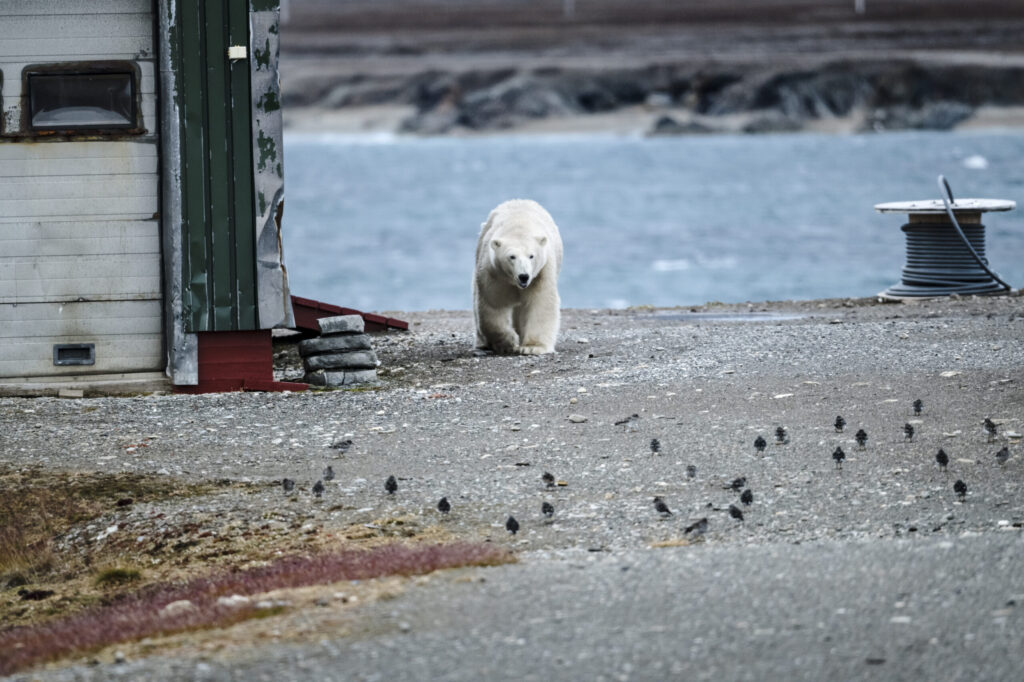
The bear was first seen by our station manager in the early morning. The bear had entered through the garage and into the storage room. He had closed the door behind him leaving him with only a narrow window as his escape route.
“It got in through the garage door which it had completely demolished and then managed to close the door behind him when entering the drink storage… the big question is: how on earth did he manage to squeeze out of that tiny window!!!” Station Manager
Only a few days ago the staff at Isfjord Radio installed a new garage door, because the previous one had also been wrecked by a polar bear visiting in February.
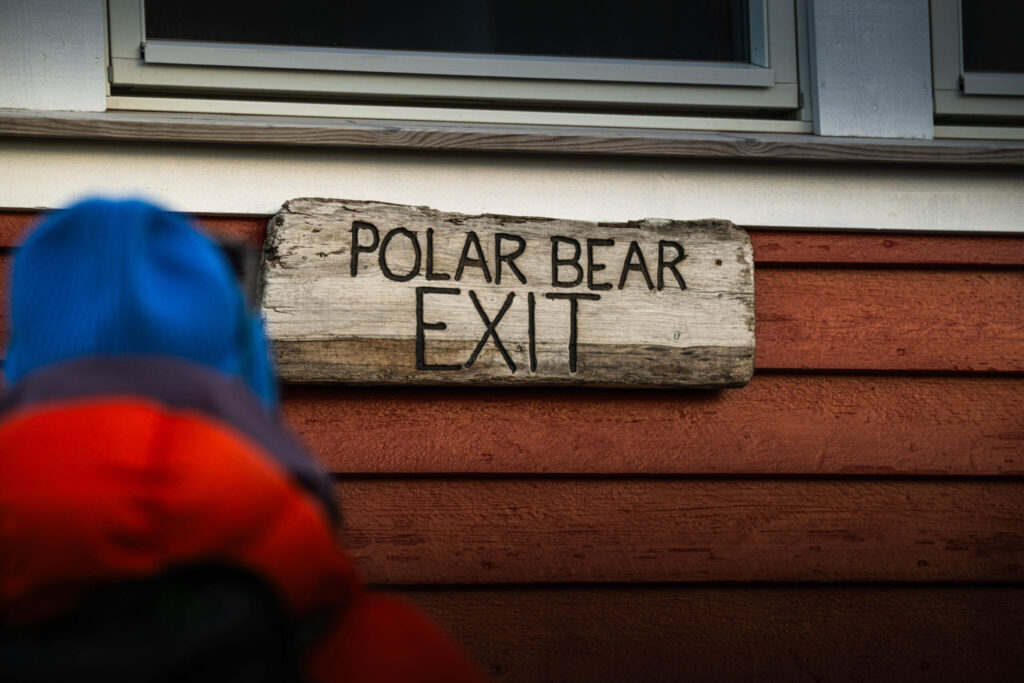
At Svalbard it does happen that polar bears break into small private cabins and supplies itself with store food. They are curious animals, and in addition to their traditional food they do not exclude a jar of jam or some chocolate. They usually leave a mess behind, which also happened this time at Isfjord Radio.
This year spring came early and seal hunting, which is its main source of food, is more challenging. It is also too early for bird eggs and the bear tries to find food wherever it can. When it finds food in one place it will usually stick around.
The governor and the staff at Isfjord Radio have had a rotating bear watch to be prepared if the bear would find his way back, and he did. On Sunday evening the polar bear came back for a brief visit before Isfjord Radio staff managed to scare him off and he disappeared into the wilderness.
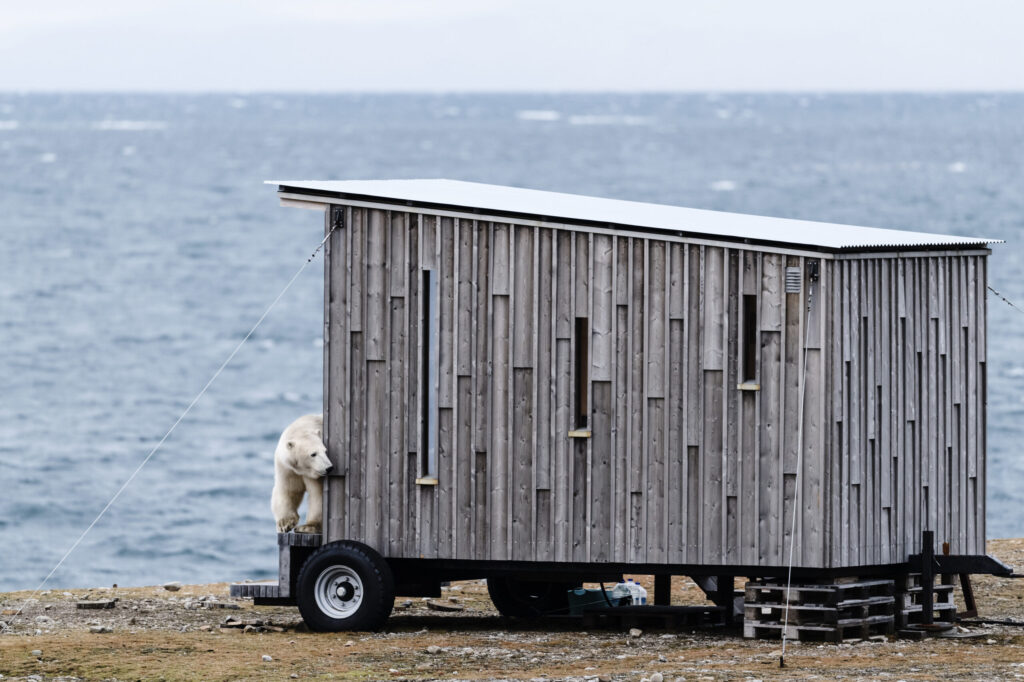
On Monday morning the governor on Svalbard searched the area with a helicopter and the bear could not be seen. A female bear with two cubs was sighted further south. The Basecamp staff observed her progress along the coastline and on a safe distance from the station she and her offspring got into the water and headed for Prins Karls Forland.
Watch the video of the polar bears visit.
Only one time before have we heard about a polar breaking into a hotel. This was in Pyramiden a few years ago when the bear visited the bar. He entered and left by himself and with no harm.
This time at Isfjord Radio our guests and colleagues were at a safe distance and could watch the polar bear from the bathroom window. The bear filled up on chocolate and escaped through the small window just as the governor arrived.
“He looked to be in good health which is very nice to see!” Malin Stark
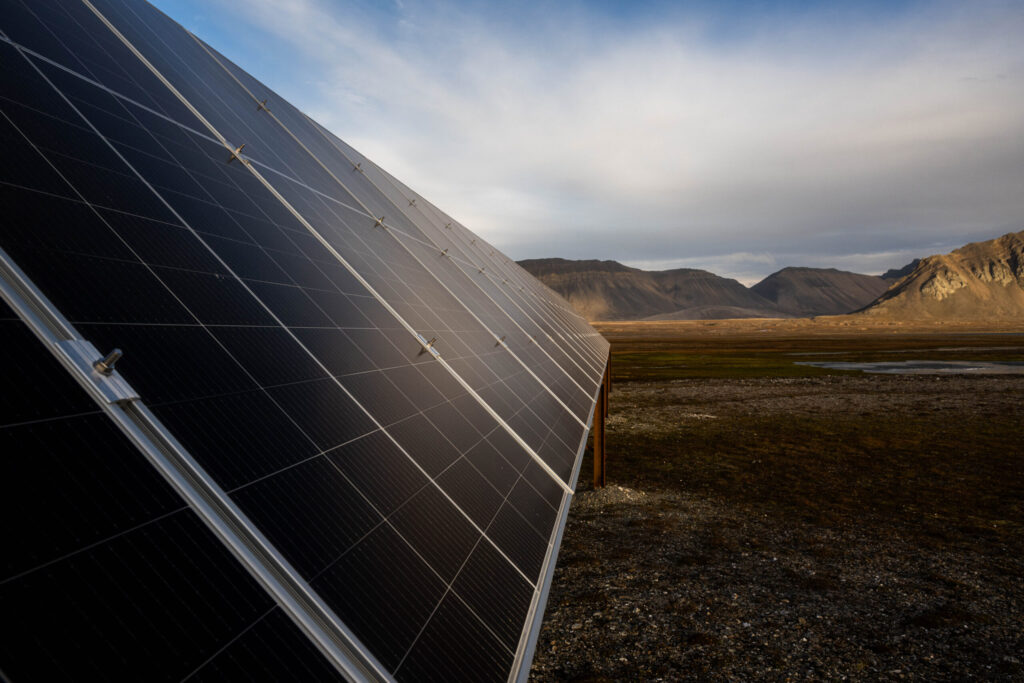
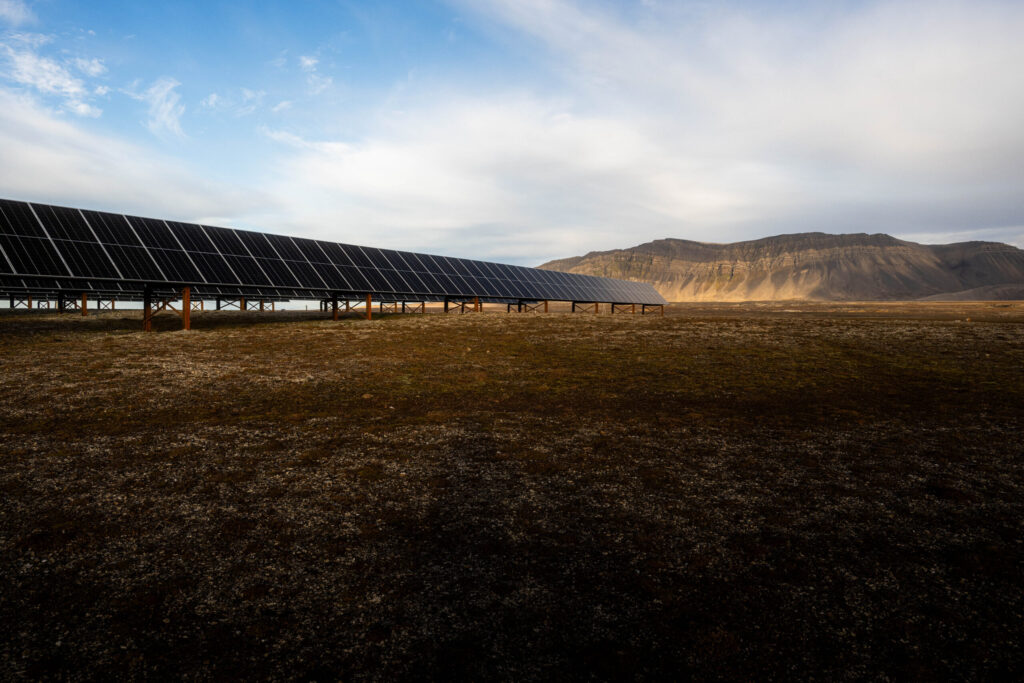
The world’s northernmost solar park has been supplying Isfjord Radio with green electricity from March 2024. The aim is for the Arctic pilot project to be taken on to remote communities, which until now have been dependent on fossil fuel.
It looks like the snow sparrows are happy with our facility, smiles Mons Ole Sellevold, project manager for renewable energy at Store Norske Spitsbergen Kulkompani. Store Norske is the owner of the radio station at Kapp Linné.
The snow sparrows have put the solar panels at Isfjord Radio into use long before the station has started running on green electricity from the plant. Up from the ground, Svalbard’s smallest bird can hide its nests from the arctic fox, which is always on the lookout for delicacies such as bird eggs.
Those who have visited Isfjord Radio in 2023 have seen six rows of 360 solar panels growing to the east of the station.
– Throughout history, people’s energy needs have affected nature, and the new plant is also clearly visible. But as owners of Isfjord Radio, we believe it is absolutely right to bet on renewable solar energy, which reduces diesel consumption by up to 60 per cent, even if the plant intrudes on the natural view, says Mons Ole.
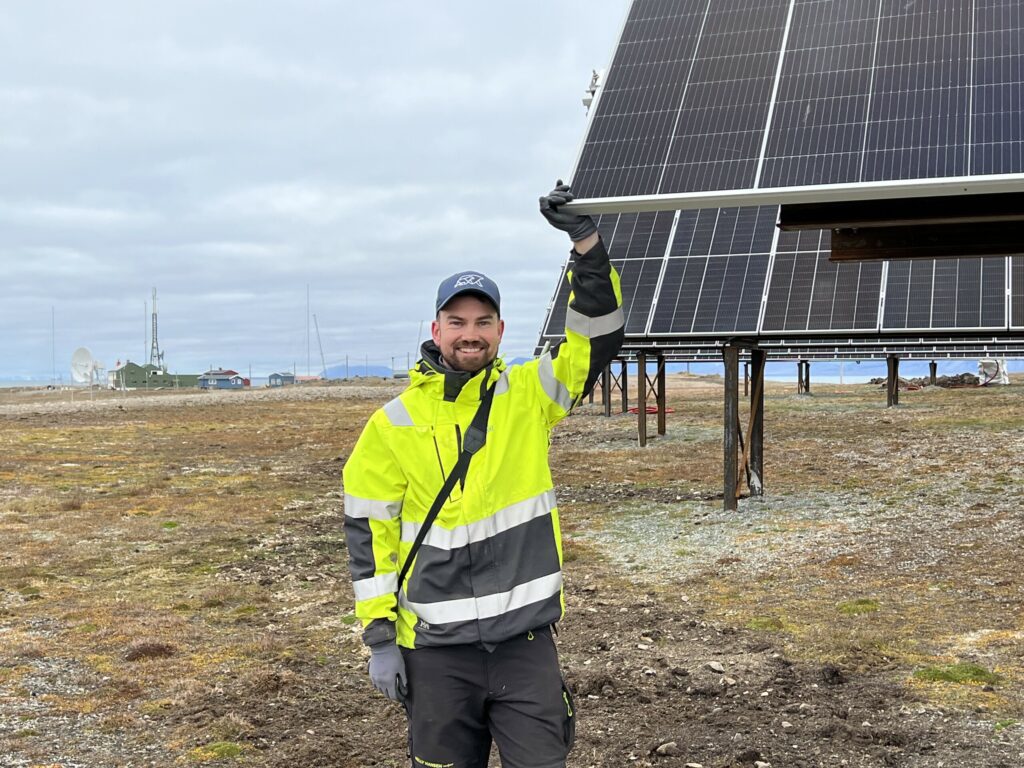
Mons Ole Sellevold at the solar park southeast of Isfjord Radio.
Store Norske’s ambition is for the facility at Isfjord Radio to act as a pilot for similar solutions for outposts and remote communities in both the Arctic and Antarctic. Not only will communities significantly reduce their own diesel consumption, the environmentally burdensome transport of fossil fuel will also drastically decrease.
Solar cells in the polar night?
From the end of October to the middle of February, Svalbard is in total darkness. Then there is little energy to be obtained from the solar system. In return, the midnight sun shines 24 hours a day from April to August, and the extensive battery pack in the basement at Isfjord Radio is fully charged.
The facility has panels facing both the sky in the south, but also towards the ground where the energy is obtained from the sun’s reflections in the snow.
– The battery pack and thermal storage consisting of series-connected hot water tanks smooth out fluctuations in energy production, explains Mons Ole.
– But it is impossible to deliver 100 percent renewable energy only from the sun and light in an area that has four months of darkness a year. We are therefore also investigating the possibilities for wind turbines, but these must take into account that there is a bird reserve next to the radio station.
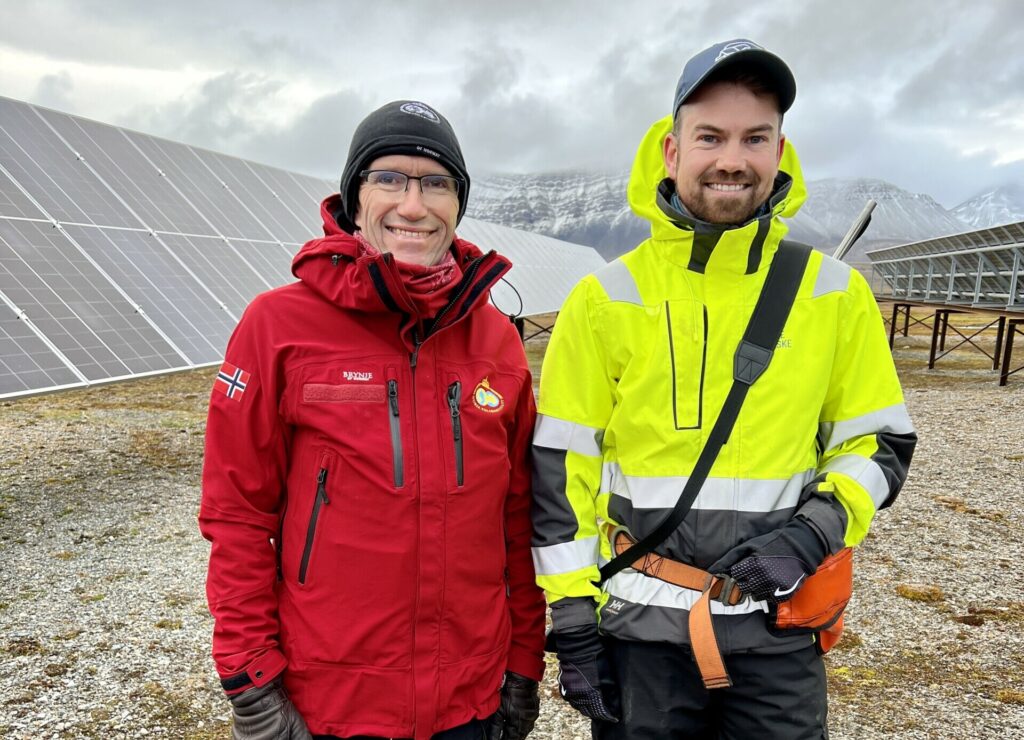
Former minister of climate and environment Espen Barth Eide gained full insight into the innovative energy plant at Isfjord Radio, autumn 2023, presented at Mons Ole Sellevold.
Diesel consumption at Isfjord Radio has historically been just under 200,000 liters per year. With the solar plant in operation, as well as various ENØK measures, Store Norske expects to reduce diesel consumption by around 60 per cent starting in 2024. The aim is to operate the plant throughout the year almost exclusively on renewable energy, and we hope the solution for a further 30 percentage point reduction of diesel consumption is in place by 2025, concludes the project manager.
Since its inception in 1998, Basecamp Explorer has had sustainable tourism as the driving force behind all activities, and the new facility at Isfjord Radio underpins the goal of a minimum footprint in the arctic climate.
Facts
- The world’s northernmost solar park
- Established by Store Norske
- Full-scale pilot project for renewable energy in arctic regions
- 360 ground-mounted solar panels + 230 roof-mounted panels
- Reduces fossil fuel consumption by 60 per cent in 2024
- Ambition for 90 percent renewable energy in 2025
- Battery pack with 400 kWh storage capacity
- Thermal storage consisting of 12,000 liters of hot water
We’re celebrating 25 years of journeying through Svalbard, driven by our mission to share its rich culture, history, and awe-inspiring nature. According to Svein Wilhelmsen, founder of Basecamp Explorer Spitsbergen, our commitment to showcasing the Arctic’s beauty and vulnerability enhances visitors’ respect for this remarkable region at 78 degrees north.
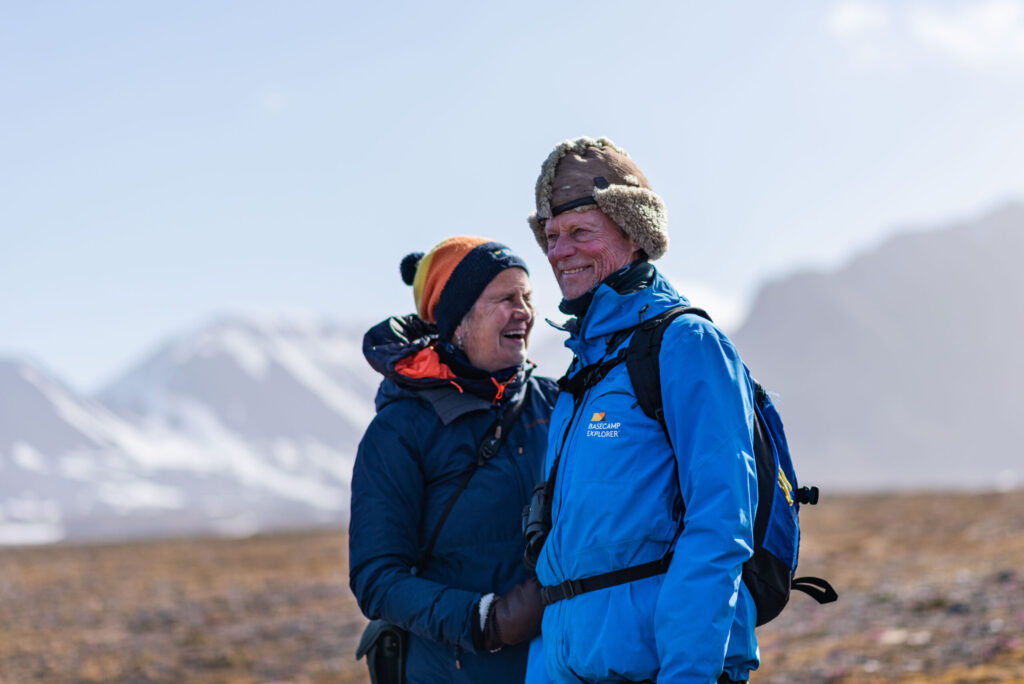
Svein Wilhelmsen founded Basecamp Explorer Spitsbergen in 1999.
Over the past quarter-century, innovation and uniqueness have defined our approach to guiding Norwegian and international guests on unforgettable adventures in Svalbard. Today, on February 20, 2024, we mark a milestone anniversary. With our flagship properties, Isfjord Radio Adventure Hotel and Nordenskiöld Lodge, we proudly stand as the sole Norwegian company offering accommodations far from civilization in the Arctic.
In 1998, Svein Wilhelmsen established Basecamp Explorer in Kenya, driven by a triple bottom line philosophy encompassing economics, environmental stewardship, and social responsibility. The following year, Basecamp Explorer Spitsbergen was born in Svalbard.
“From the equator in the south to the Arctic in the north, we’ve shared two destinations facing environmental pressures due to human impact,” says Svein Wilhelmsen. “Our operations have sparked numerous projects promoting a harmonious balance between people and the environment.”
“Svalbard has captivated explorers, trappers, and researchers for centuries, and its allure endures,” he continues. “Our journeys aim to inspire, with guests experiencing a blend of mastery, wonder, and joy in encountering the Arctic.”
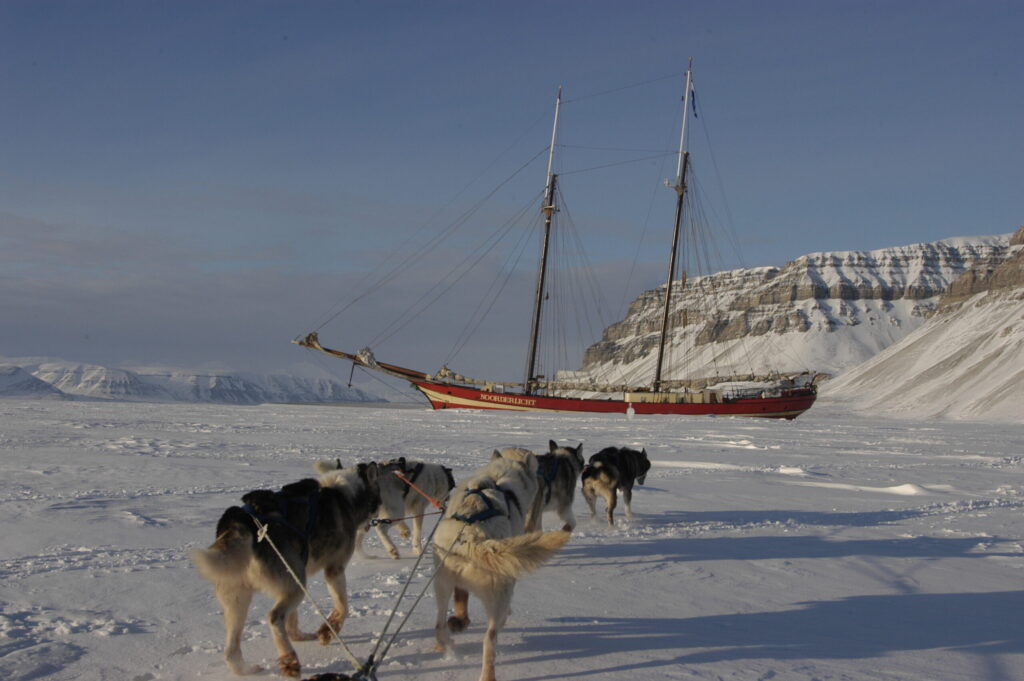
Alternative accommodation options have evolved over the years. While we once transported travelers to the ‘Ship in the Ice,’ now deemed unsafe due to unstable fjord ice and increased regulation, we’ve adapted. In 2008, we assumed management of Isfjord Radio, transforming the former radio station into a cozy wilderness hotel accessible by snowmobile, ski, or dog sled from Longyearbyen. During summer, guests journey by boat to the hotel at Kapp Linné.
Nestled amidst the moraines before the imposing Nordenskiöld Glacier lies Nordenskiöld Lodge. Norway’s northernmost commercial cabin offers an intimate retreat from modern life, accommodating just eight guests amid rugged yet breathtaking wilderness.
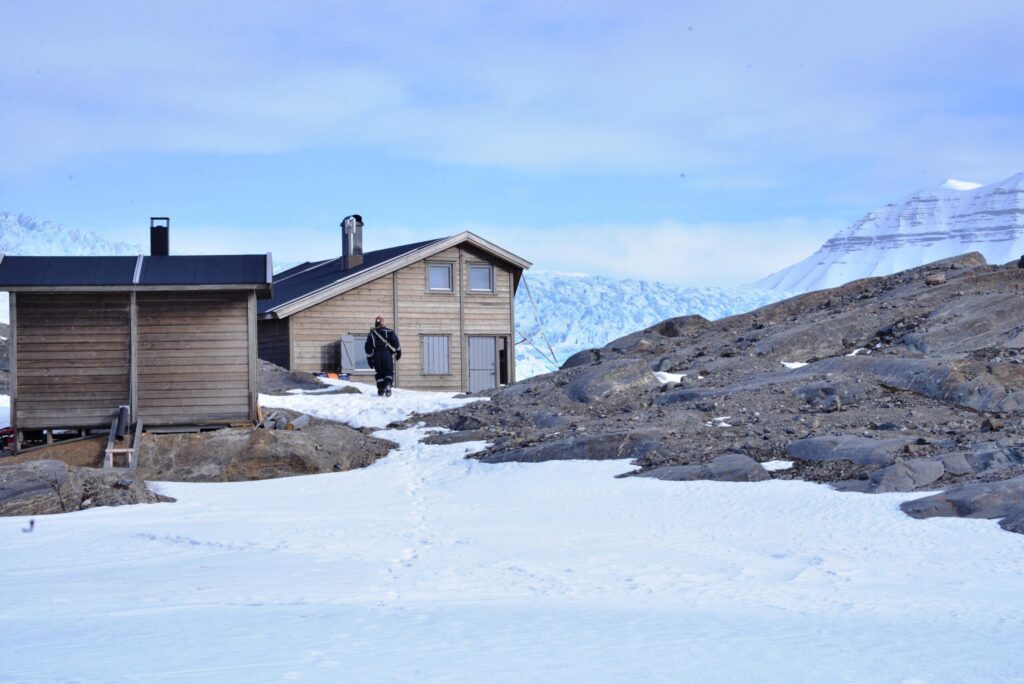
“Our 25 years of distinctive tourism production in Svalbard reflect our commitment to delivering extraordinary Arctic experiences,” asserts Renate Pedersen, General Manager of Basecamp Explorer Spitsbergen. “We infuse each adventure with a touch of madness, ensuring safety and compliance with authorities’ regulations.”
“In 2023, we were honored as Norway’s best experience provider, a testament to our dedication to delivering exceptional experiences,” adds Pedersen. “As we celebrate our 25th anniversary, I extend heartfelt gratitude to all who have contributed to sharing Svalbard’s remarkable history and nature.”
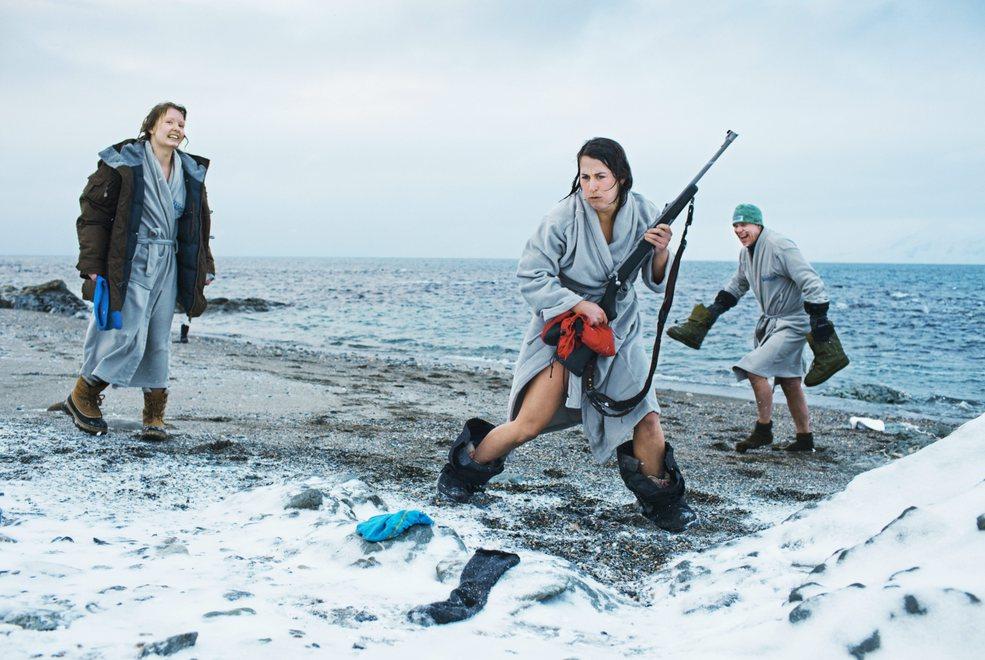
A touch of madness by Basecamp Explorer Spitsbergen.
Looking ahead, Flakk Gruppen became the primary shareholder of Basecamp Explorer Spitsbergen in 2023, signaling a commitment to shaping future experience-based tourism in the Arctic. As the third-largest Norwegian tourism operator in Svalbard, we continue to expand our portfolio, which includes Basecamp Hotel in Longyearbyen and the Catching Station in Bolterdalen, along with a dog kennel housing up to one hundred Alaskan huskies.
“Our operations prioritize environmental stewardship, and our Arctic expeditions promote awareness of the world’s environmental challenges,” concludes Renate Pedersen. “We hope our guests depart with a newfound sense of mastery and affection for the Arctic, inspiring collective action for a sustainable future.”
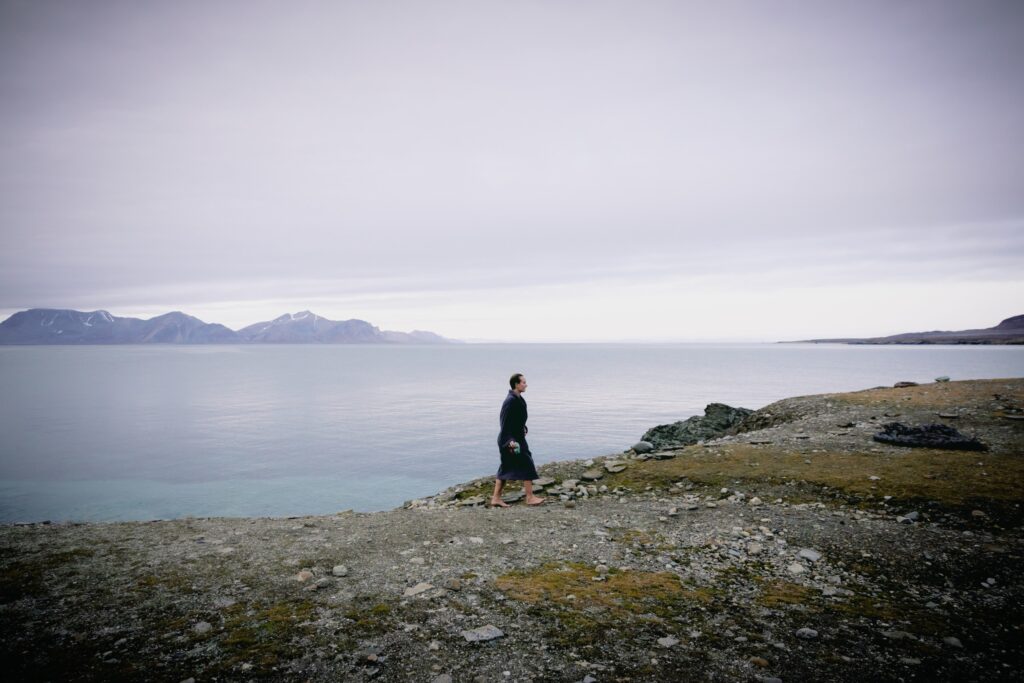
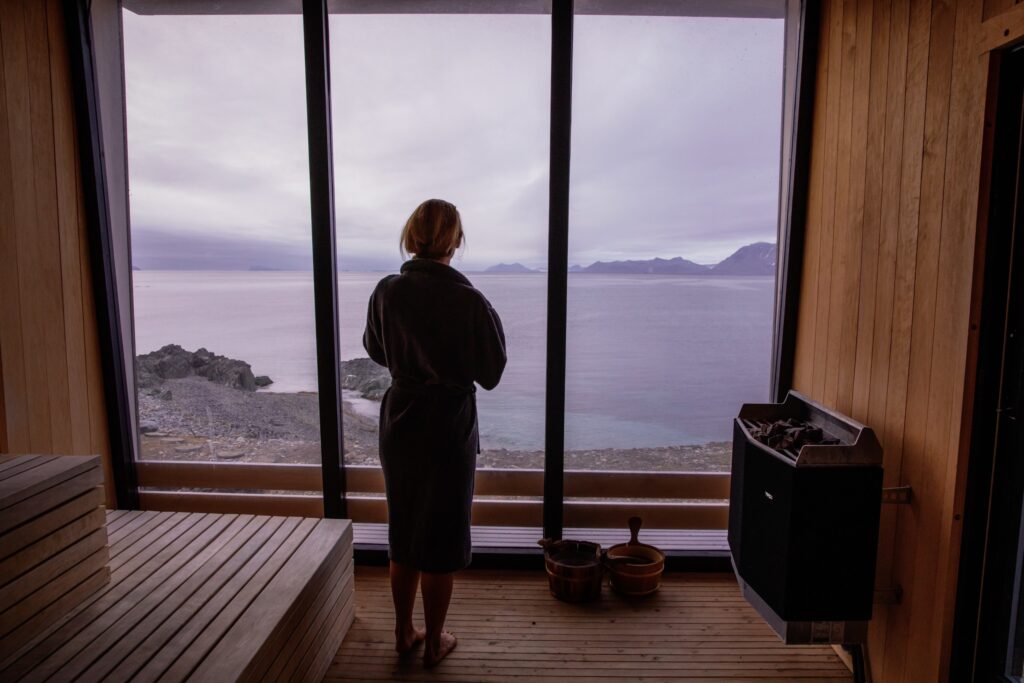
Through the wall-to-wall panorama window, the horizon stretches endlessly across the Arctic Ocean. Somewhere beyond lies the coastline of Greenland. Turn slightly north, and you are facing the direction of the North Pole.
Outside, fulmars glide effortlessly along the cliffs. A group of belugas may pass close to shore, white against the dark water, while a curious seal surfaces and disappears again. The landscape is vast, exposed and alive.
And you are watching it all from the warmth of a sauna.
The idea of an Arctic Spa was born when Basecamp Explorer established Isfjord Radio as an adventure hotel more than a decade ago. After long days on snowmobiles or out exploring the tundra, what could be more restorative than stepping into a hot sauna by the shore?
Sauna culture here is not new. As early as the 1950s, the original station staff built a sauna inside the main building. At the time, Isfjord Radio functioned as a vital communication link between mainland Norway and Svalbard, staffed year-round. The sauna offered warmth, comfort and a safe retreat from both weather and wandering polar bears.
Today, that tradition continues, reinterpreted in a modern, architectural form.
WHAT IS THE ARCTIC SPA?
The Arctic Spa concept is simple: nature is the main element.
The sauna was designed with a full panorama window so you can lie back on the benches and let the Arctic unfold before you. No screens. No distractions. Just wind, sea, light and silence.
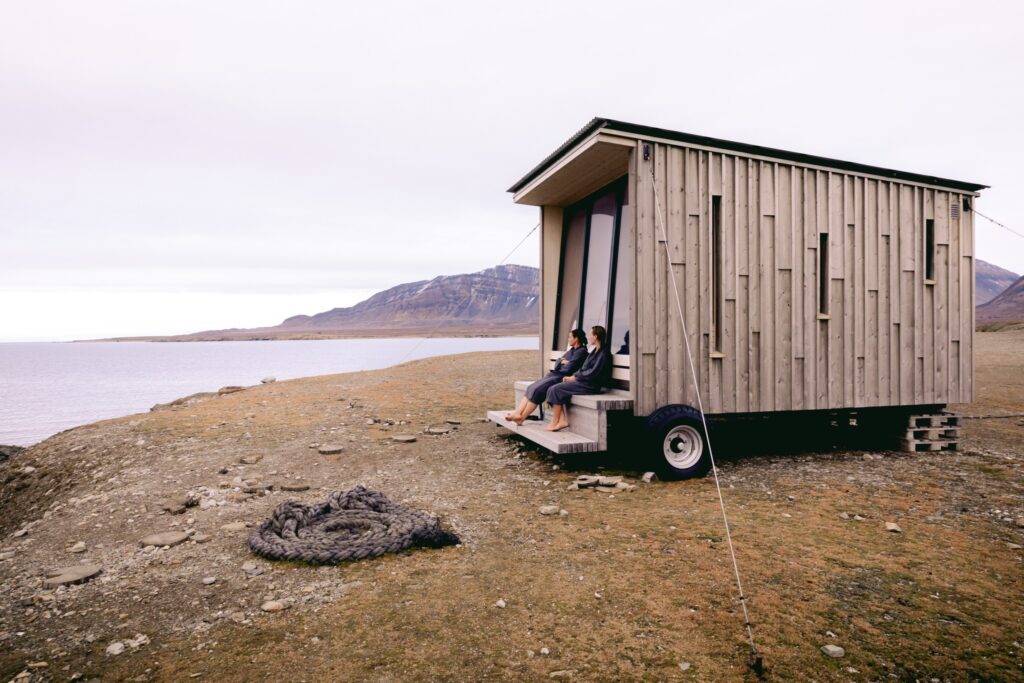
To follow the changing seasons and ensure safety in polar bear territory, the sauna was built as a mobile structure. It can be repositioned when needed, always balancing immersion with responsibility.
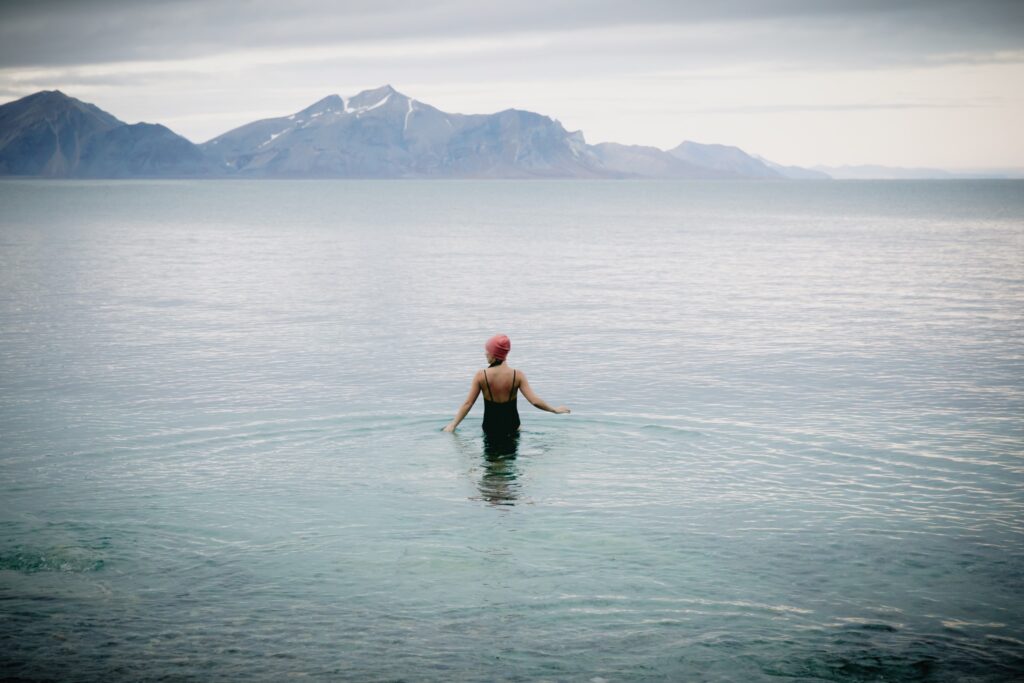
The second essential element is the ocean itself. A plunge into the icy sea, followed by the return to the heat of the sauna, creates a powerful contrast, cold and warmth, exposure and shelter. It is invigorating, grounding and deeply restorative.
Second part of the Arctic Spa experience is the Ocean. There is no better feeling than first dipping yourself to the icy ocean and then running back to the warm sauna to warm up your toes and fingers again. Is a combination of adrenaline rush and relief that makes you wanting more. Are you ready to try?
Built for the Edge of the World
Constructing a sauna 90 kilometres from the nearest road or airport is no small undertaking. Designed by architects and engineers for Arctic conditions, the structure is both robust and refined.
Built from massive timber, the sauna combines environmental responsibility with Scandinavian design precision. Treated spruce clads the exterior in a drift-grey tone that withstands harsh weather. Inside, smooth aspen walls and benches create a calm, modern atmosphere. Every detail is crafted with millimetre accuracy.
Weighing five to six tonnes, the structure rests on a steel frame with integrated wheels, allowing it to be moved by tractor when needed. Transporting it to Isfjord Radio required crossing the Arctic Ocean by cargo ship, followed by transfer by smaller boat from Longyearbyen — a demanding journey that reflects the remoteness of its destination.
The Cookery
The sauna carries the name The Cookery, inspired by Svalbard’s whaling history. During the 1600s and 1700s, whales were brought ashore and processed in coastal cookeries where blubber was rendered into oil.
Along the coast towards Barentsburg lies Kokerineset, or Cookery Cape — a reminder of this chapter in Arctic history. By naming the sauna The Cookery, we honour the stories embedded in this landscape and connect modern architecture with centuries of human presence in Svalbard.
The Arctic Spa at Isfjord Radio is more than warmth against the cold. It is contrast. Perspective. Presence.
There is no better way to travel across the frozen tundra than on a husky-drawn sled. With no engine to interrupt the silence, the only sounds are the swoosh of the sleigh and some occasional barks from overenthusiastic dogs.
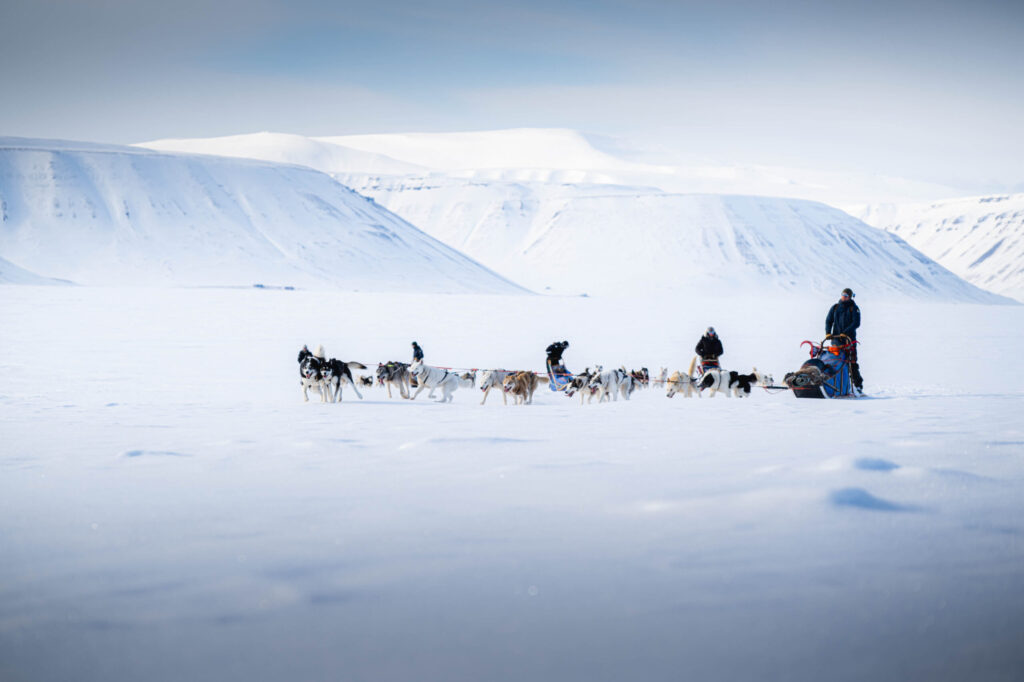
Dog sledding consists of teams of six dogs harnessed to wooden sledges, whilst the driver, or ‘musher’, stands behind the dogs on runners. The first team, driven by the guide, is directed by voice commands. Other teams follow faithfully, so as a guest, your task is to control the speed by using the break.
Dog sled teams are comprised of leader dogs, swing dogs and wheel dogs. Lead dogs run in front and are chosen for their courage and bravery; behind them, swing dogs help with turning, while wheel dogs provide the brute strength needed to break the sled out from the snow.
We start with instructions of how to mush your own dog team. Guide will show you how to drive the sledge and how to harness the dogs. The main rule is never let go of the handlebar. Secondly, you have to remember to use the brake.
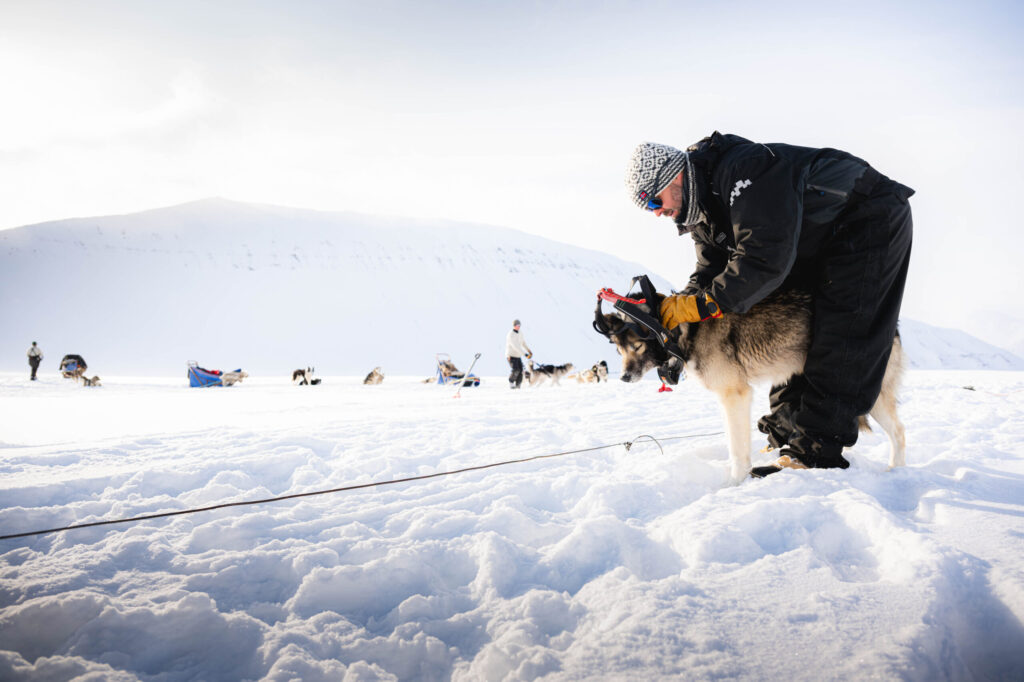
If you are heading for an overnight trip, it’s time to pack your belongings to the sledge. There is not that much room, so you can leave your luggage at Basecamp Hotel and only take the necessary items with you.
Then it’s time to harness your own team. For the first time it might take some time, but you will become the master after a few times.
Then it’s time to go! The dogs are really eager at the beginning and have quite a power, so do remember to stand on the break when you start.
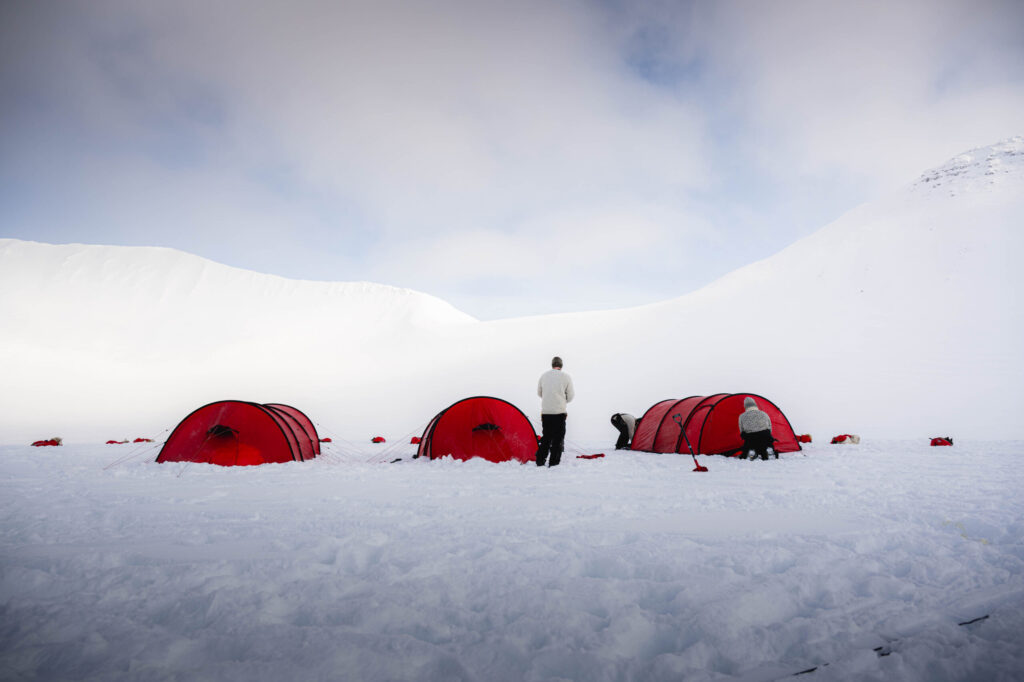
Important part of the mushing is to take care of the dogs. After a long day of running, it’s time to unharness the dogs and feed them. Some gentle pets and hugs for the dogs are always welcome before heading for our own dinner.
Some trips are overnight, while others return back to Longyearbyen the same day. If tent accommodation is not really your style, there are other outlying stations for you to choose from. Accommodation at Isfjord Radio Station or a cabin will add some comfort to the musher’s life. It’s your choice: pick whichever suits you best.
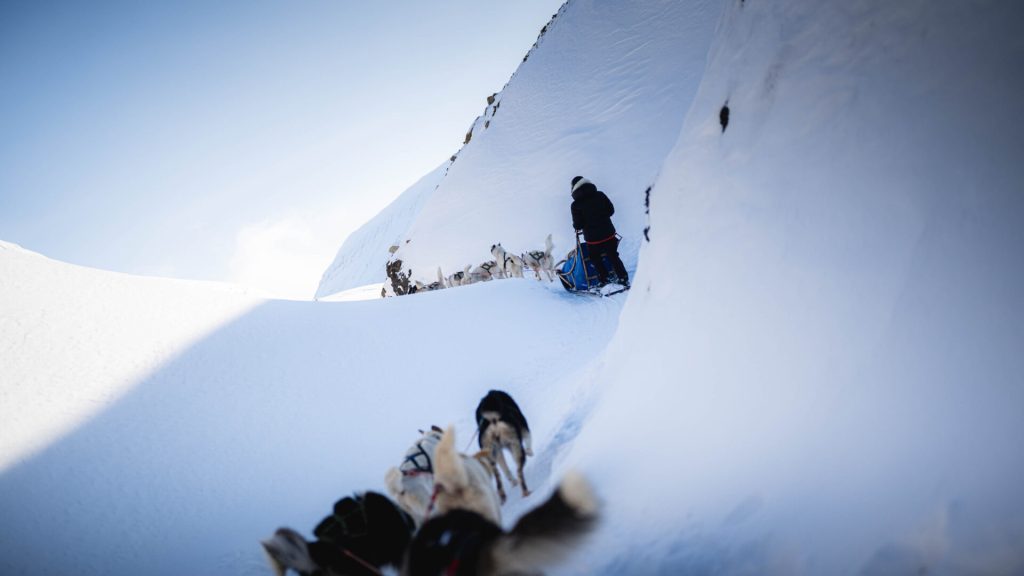
In the High Arctic, nature does not negotiate.
Weather changes without warning. Sea ice shifts. Snow conditions evolve hour by hour. In this environment, guiding is not about following a script. It is about making sound decisions, calmly, confidently and with deep knowledge.
That is why Arctic decision-making is at the core of how we train our guides.
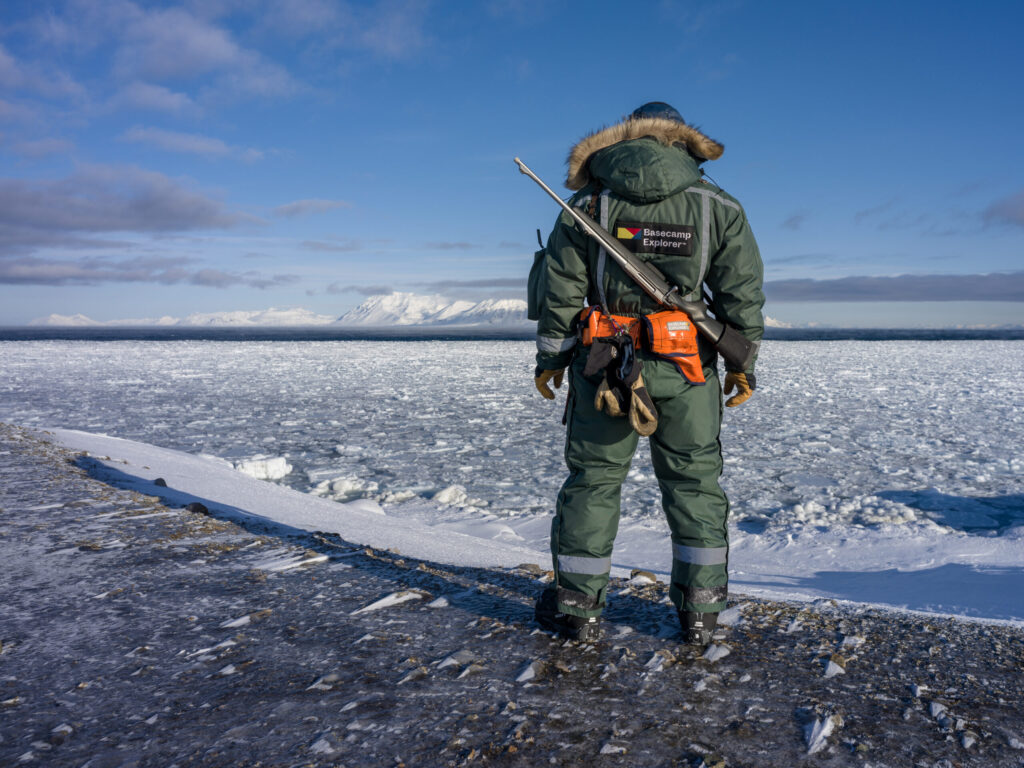
Photo: Christopher Michael
All our guides are formally trained Arctic Nature Guides. Their education provides a solid foundation in Arctic ecology, geology, history, safety management and outdoor leadership. It ensures that every guide understands not only how to operate in this environment, but how to interpret it.
Guiding in Svalbard requires more than practical skill. It requires context, responsibility and respect.
Before every season, our entire guide team gathers for an intensive week of practical and theoretical training.
This is not a formality. It is essential preparation.
During this week, guides:
- Complete avalanche safety training
- Review and assess glacier routes and travel techniques
- Refresh and test first aid skills, including cold-related injuries
- Train in snowmobile and boat handling and technical safety procedures
- Revisit risk assessment frameworks and emergency protocols
We practice scenarios. We challenge assumptions. We discuss real-case situations from previous seasons. Decision-making is not treated as instinct — it is treated as a skill that must be trained and maintained.
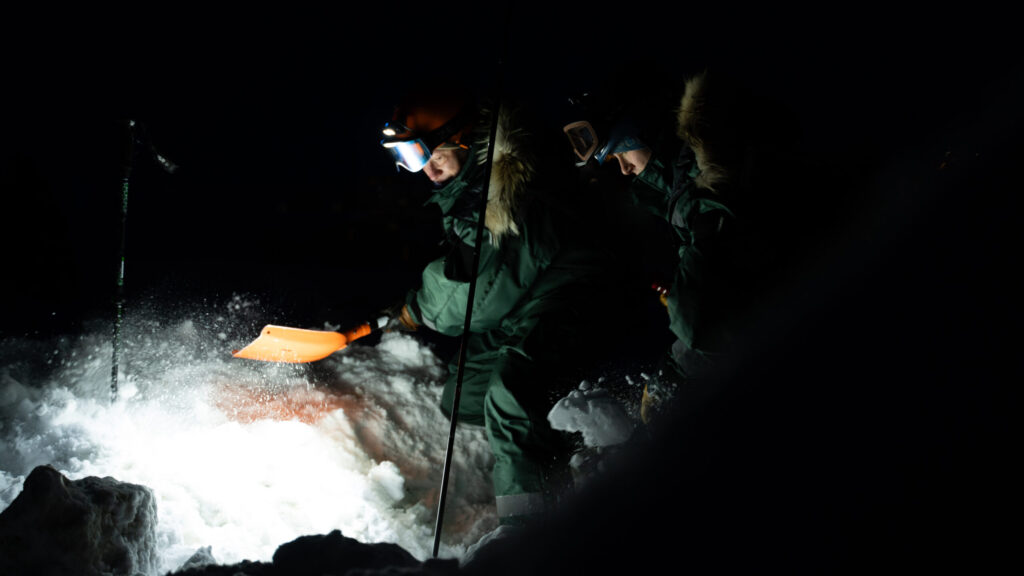
The Arctic is one of the fastest-changing regions on the planet. Sea ice conditions, wildlife behaviour and weather patterns are constantly evolving.
Our guides therefore update themselves on the latest research related to Arctic conditions, climate development and environmental management. Through partnerships with researchers and local experts, we ensure that our knowledge reflects current science, not outdated assumptions.
Understanding change is part of making safe decisions.
Technical skills matter. Equipment matters. Experience matters.
But in the Arctic, what matters most is judgement.
When to proceed.
When to turn around.
When to adjust the plan.
We train our guides to balance guest experience with safety, always prioritising responsibility over ambition. True professionalism in the High Arctic means knowing that the most impressive decision is sometimes the one that avoids unnecessary risk.
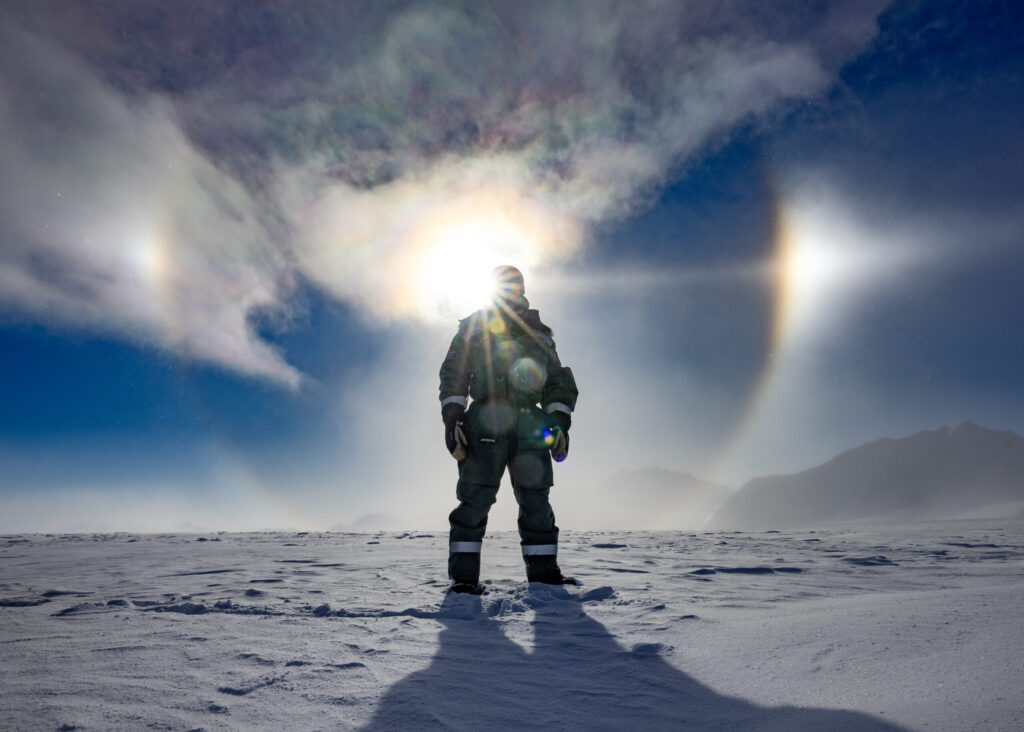
Photo: Christoffer Michael
Arctic decision-making is not a single course or checklist. It is a culture.
It lives in daily briefings. In open discussions after each trip. In the humility to continuously learn. In the courage to make conservative choices when conditions demand it.
Our guests may remember the wildlife encounters, the vast landscapes and the silence. What they do not always see is the depth of preparation behind every journey.
In the High Arctic, experience is built on expertise.
And every safe return is the result of deliberate, informed decisions.
Ready for a wild winter adventure? Put on a thermal suit and helReady for a winter adventure that stays with you long after you return home?
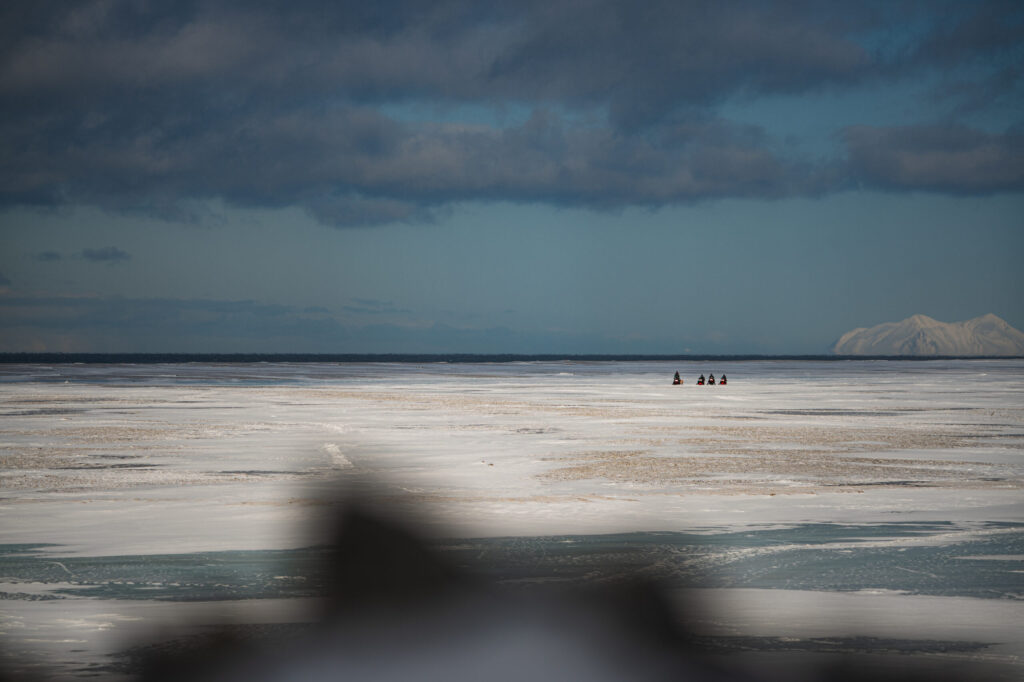
Pull on your thermal suit and helmet. Settle onto the snowmobile. Then follow your guide into the vast Arctic wilderness. We warn against experiences that settle deep and well in the body and mind.
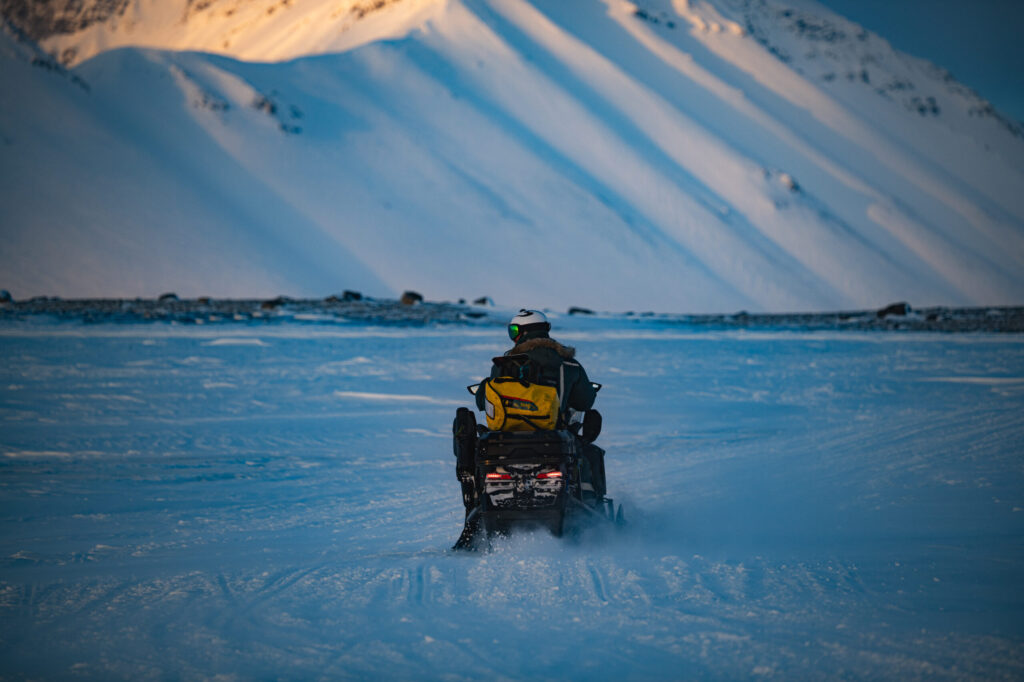
Within minutes of leaving Longyearbyen, civilisation fades. The horizon opens. Snow-covered valleys stretch ahead, frozen lakes shimmer beneath you, and Svalbard’s dramatic rock formations rise from the white landscape. Out here, nature surrounds you in every direction.
The journey to Isfjord Radio Adventure Hotel on the outer rim of the west coast is exhilarating, demanding and deeply rewarding. Led by experienced Arctic guides, you travel safely through ever-changing terrain, learning to read weather, snow and light along the way.
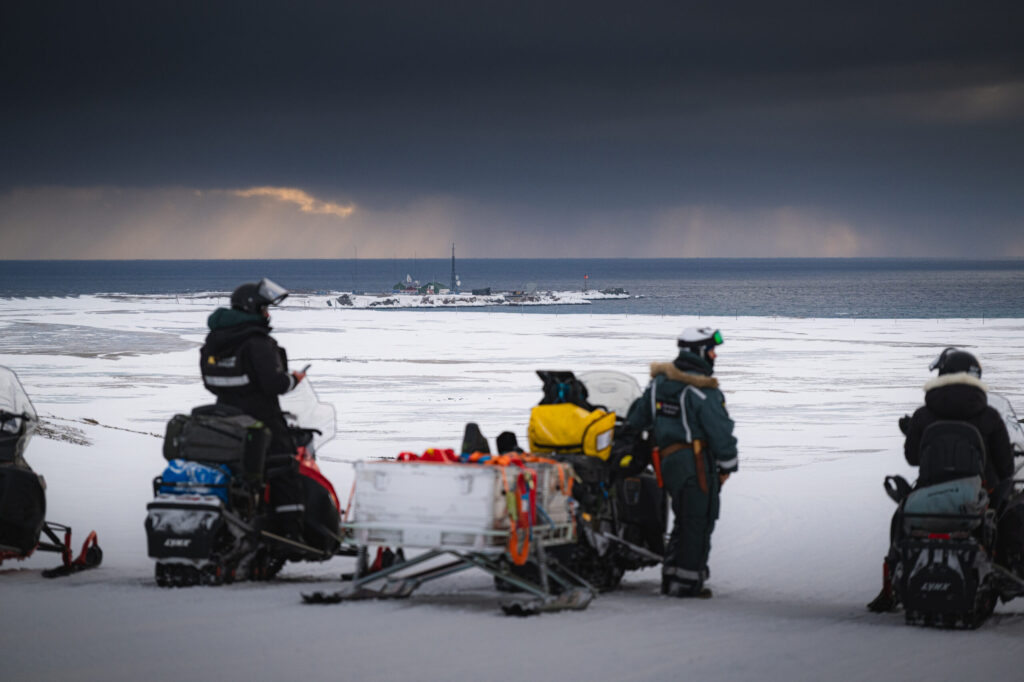
At Cape Linné, your hosts await. Candles flicker in the windows. Slippers and wool blankets are laid out. In the kitchen, dinner is prepared from local ingredients; Svalbard reindeer, ptarmigan and fish from the Arctic Ocean, accompanied by freshly baked bread still warm from the oven.
Originally built in 1933 as a radio station, Isfjord Radio has been transformed into a refined and characterful retreat. Norwegian interior designer Halvor Bakke has brought the Arctic colour palette indoors, blending contemporary comfort with preserved historical details.
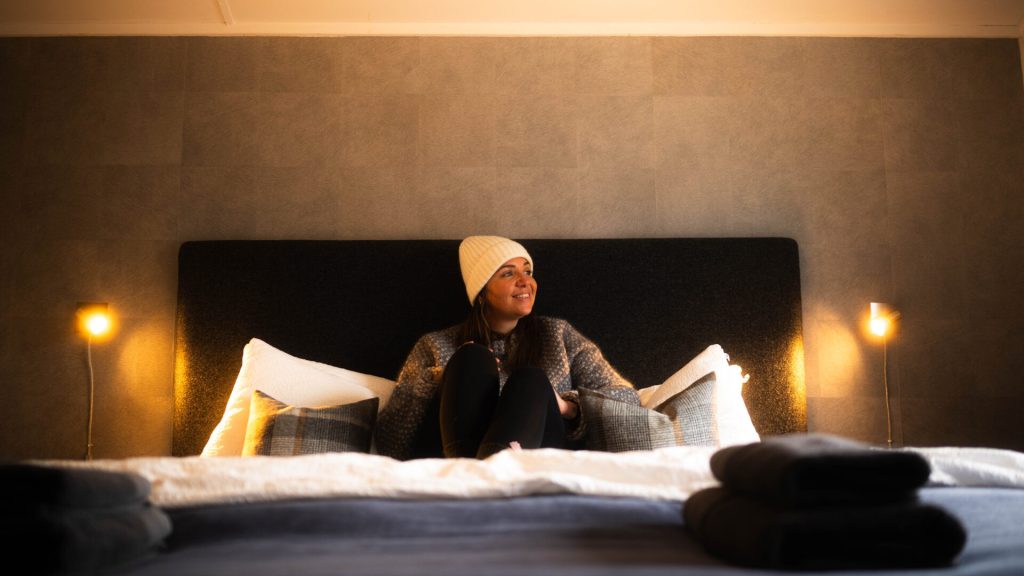
And do not forget your swimwear.
On the shoreline stands Kokeriet, our panoramic sauna facing the Isfjord and the open sea beyond. From the heat of the sauna, you may spot seabirds riding the wind, perhaps even a walrus passing offshore. The brave take a dip in the Arctic Ocean before returning to the warmth, earning their place among our Arctic swimmers.
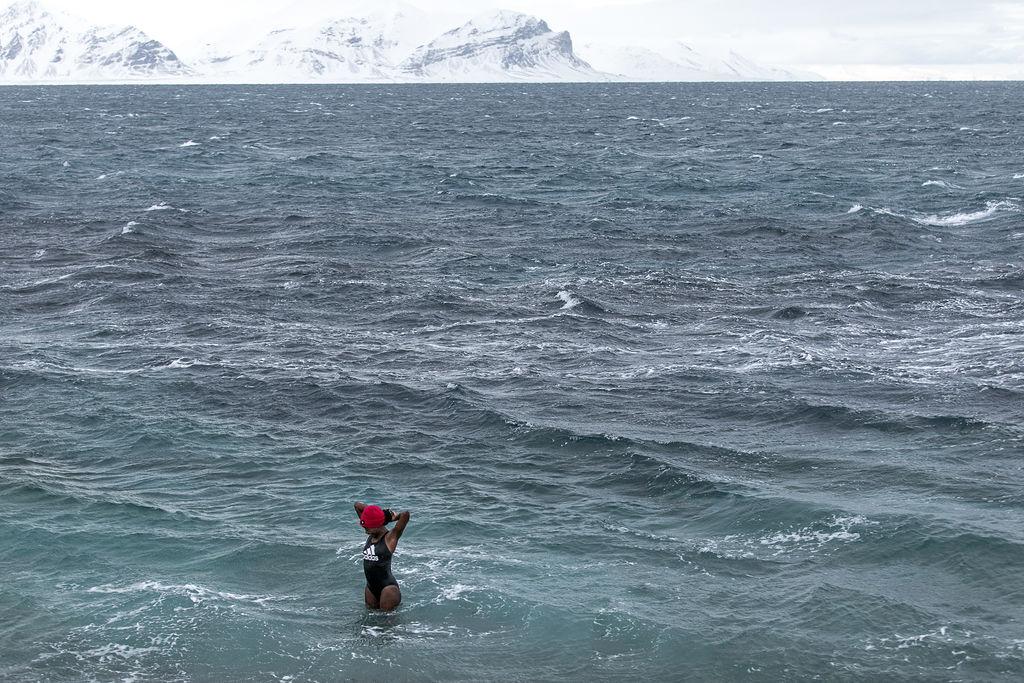
To truly experience Svalbard, you must venture beyond town and into the wilderness. Basecamp Explorer Spitsbergen is the only Norwegian operator offering accommodation outside Longyearbyen, at remote hotels and serviced lodges where the landscape sets the rhythm.
This is where the Arctic reveals itself and the journey becomes unforgettable.
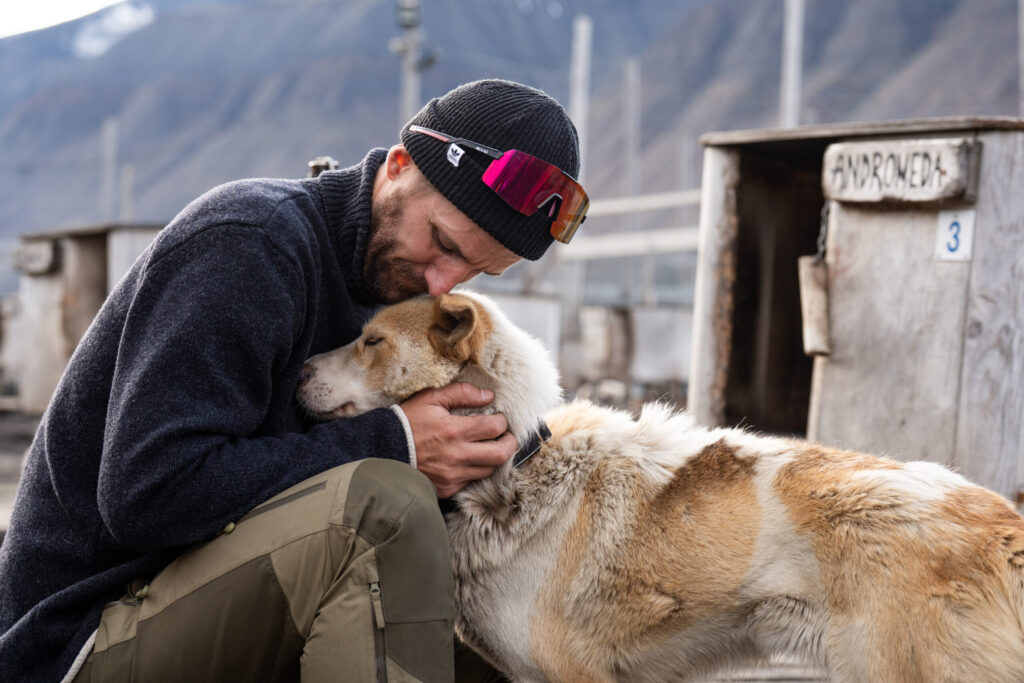
Facts about our dog yard
Location: Bolterdalen, 10 kilometers east of Longyearbyen
Dog breed: Alaskan husky
Number of dogs: Approx. 80, 50-50 male and female
Use: Sleigh rides and companionship
Why Alaska husky?
We have chosen Alaska huskies because they are very friendly and trusting dogs with a good disposition. They are social individuals, who love to live in groups. The Alaskan husky is a hard-working sled dog with great endurance. They are also easy to train and are very loyal.
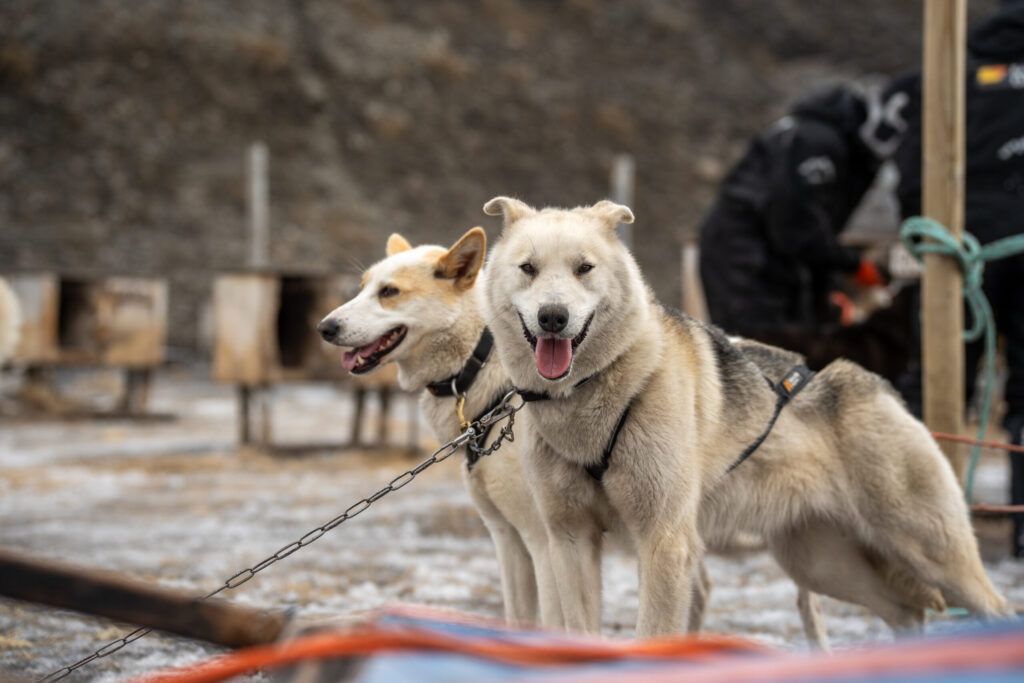
What characterizes the Alaskan husky?
The Alaskan husky is not a purebred dog. It was bred from a cross between different dog breeds with qualities that have been desirable for this type of working dog. The origin stems from polar primordial dogs in Alaska and northern Canada, but has today through breeding lines obtained qualities from, among others, bird hunting dogs and the Siberian husky.
Alaskan huskies are very persistent, fast and hard-working sled dogs. They have a friendly disposition, are loving and are experienced as a loyal travel companion. They are social individuals, and it is important for an Alaskan Husky to surround himself with either other dogs or his human family. They are intelligent beings and love to learn.
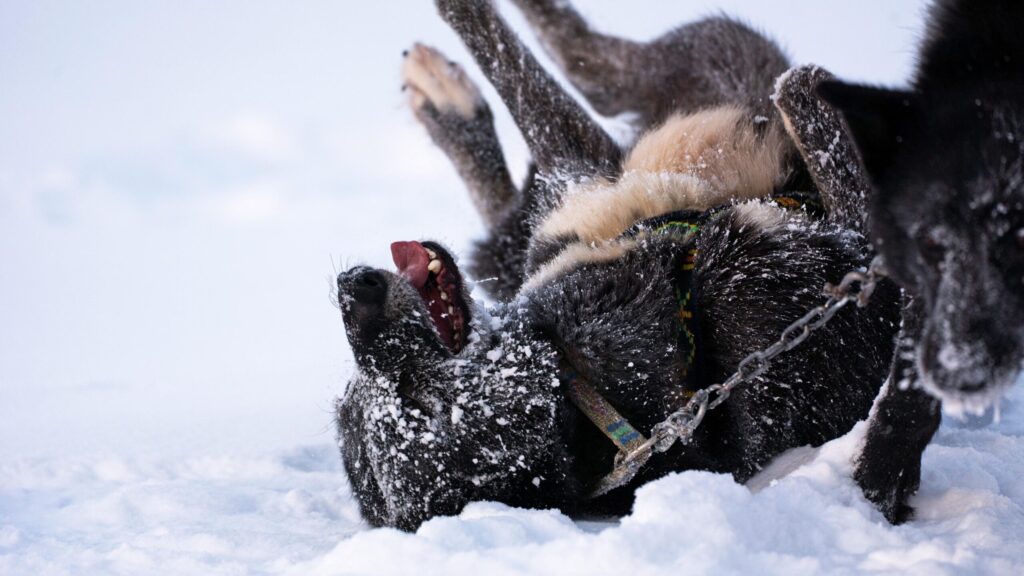
Alaska huskies are very different in appearance, based on the fact that they are not purebred dogs. They come in various designs and shades of color including white, brown and black. Most have a narrow build, but some are more solid and broad. The dogs have either blue or brown eyes, and many actually have one blue and one brown eye. Females weigh 20-25 kilos, while a powerful male can weigh up to 35 kilos.
Alaskan huskies have a coat that consists of an inner layer of undercoat and an outer layer of top hair. The underwool keeps the dogs warm, while the outermost layer can be compared to a shell covering that closes against wind and precipitation. Dogs do not cool themselves with sweat through their skin as humans do, but rather through their breath and paws. This is how they seal the heat in, and with the help of the two layers of fur, the Alaskan husky stays warm down to -30 degrees Celsius, making it a robust dog in arctic regions. The dogs thrive in the cold, which you can see by the fact that they often lie curled up on the ground, and often under a good layer of snow.
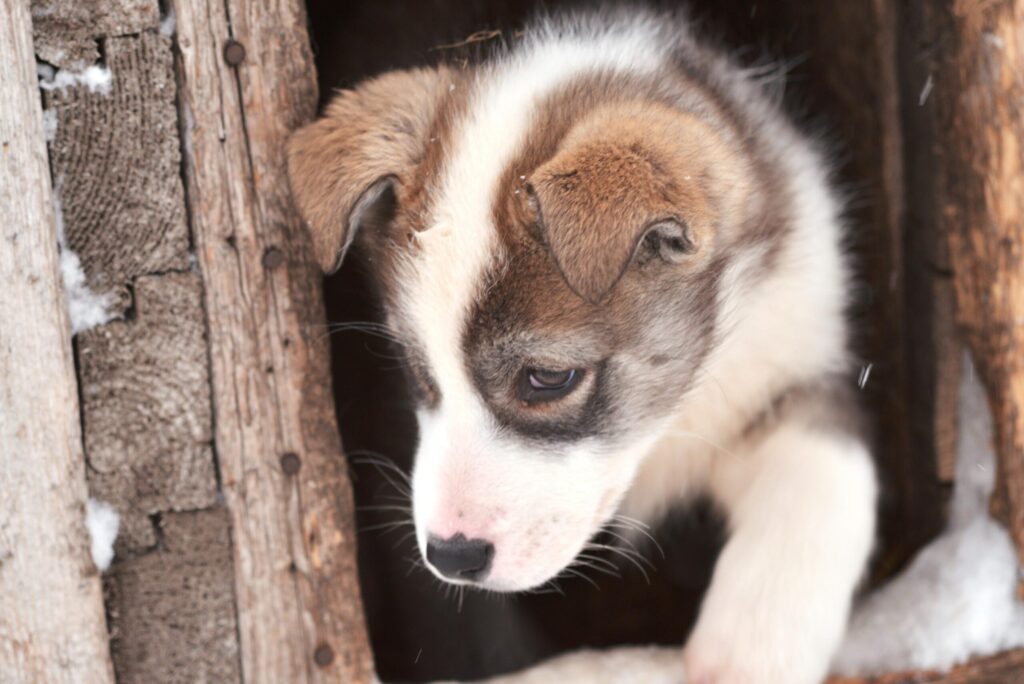
The dog’s life course
A female is pregnant for approximately two months. Well before birth, we take the female into a closed room with its own yard. The room is covered with wood wool to keep mother and puppies warm and the floor soft. We always try to be present at birth, so that we can assist in the event of complications.
When the puppies are born, they automatically seek the mother’s teats to take in mother’s milk with important nutrients for the puppies so that they grow into healthy and fit dogs. The puppies grow quickly, and after two weeks they open their eyes. We spend a lot of time with the puppies after they have grown more robust. All the puppies try to copy their mother and they fight for attention. Then it is quickly done that a shy puppy can disappear in the crowd, and we have to actively help the little one with socialization.
When the puppies are four to six months old, they can begin a cautious approach to life as a sled dog. First, they must learn to walk with a harness, before they can be trained to pull. Then comes the big test of strength: Which position will suite the dog will be in the team?
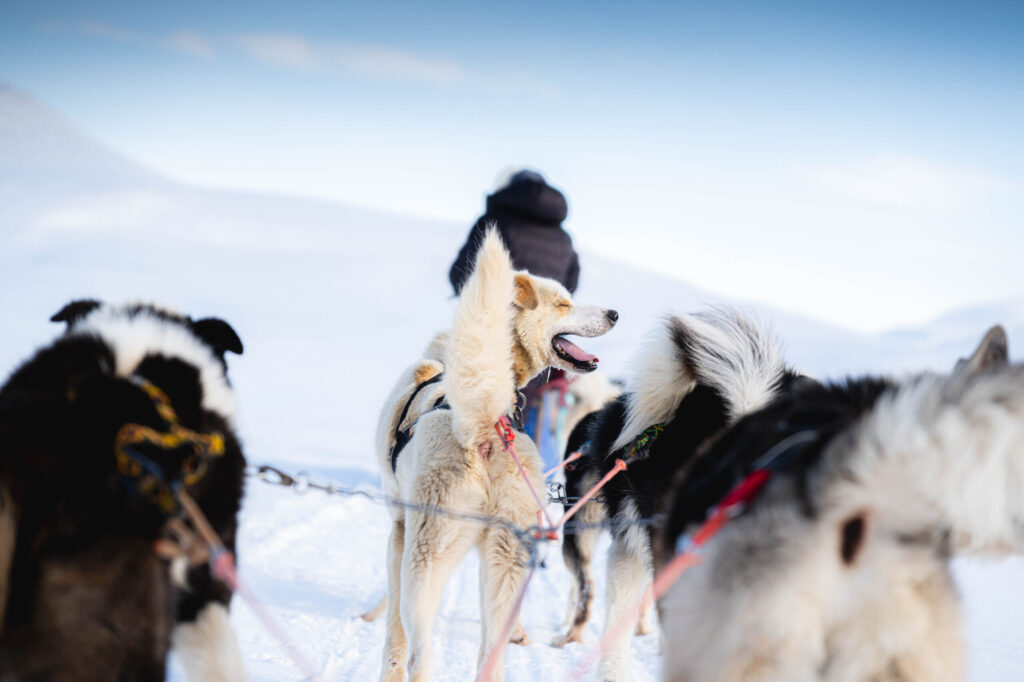
Guide dog, swing dog, sled dog or four-wheel drive?
The lead dogs are the ones put first in the team, who are responsible for keeping the line taut and pulling the team forward at a good pace. It is mostly females that are leader dogs. The boys have so much testosterone and adrenaline in their bodies that they lose concentration. We can often see early signs of whether a females will be a good leader dog. The swing dogs respond to the commands right and left, and steer the team in the right direction. The task of the sled dogs is to work steadily, while the four-wheel tractors are often the strongest, which are placed closest to the sled.
Alaskan Huskies love to struggle out in the field. They simply feel better from exerting a lot of energy in cold environments. As the temperatures rise, an Alaskan husky finds it hard. The fur is so thick that the dogs become more relaxed the more plus degrees they work in.
All our dogs are trained regularly, and we have forms that indicate the date, kilometers and level of effort for each training and long-distance walk that the individual dog undertakes. We quickly notice if a dog has not had enough mental and physical exercise, then it becomes restless and grumpy, something we do not want our dogs to be.
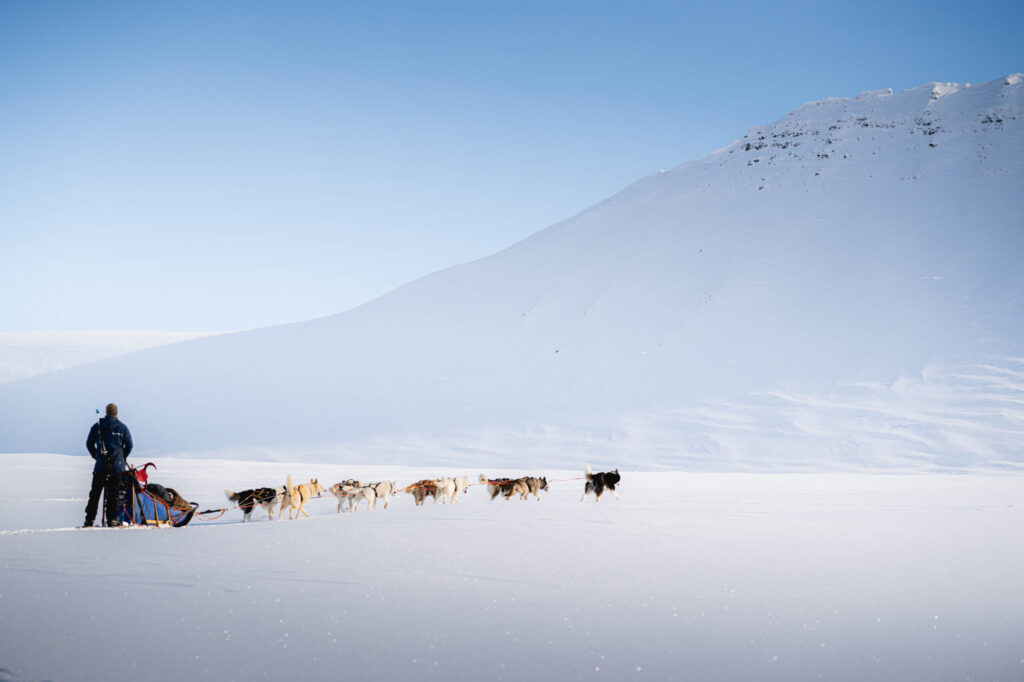
The dogs that are selected for longer expeditions must be specially trained for this. Then the length of the training trips is increased long in advance. They can run up to 40-70 kilometers a day on our trips. To put it in perspective, a well-trained racing dog that participates in the major competitions can run up to 200 kilometers a day.
After many years as a sled dog, the dogs’ physique deteriorates, just like with us humans. Then they move into retirement, and that usually means they move from the dog kennel in Bolterdalen. Someone gets to become a station dog at Isfjord Radio, others move to a selected family who guarantees that they will take good care of our four-legged friends.
PS: A few Alaskan Huskies do not enjoy being in packs or working as sled dogs. Then we find a good alternative for the dogs, and they move from Bolterdalen at a young age.
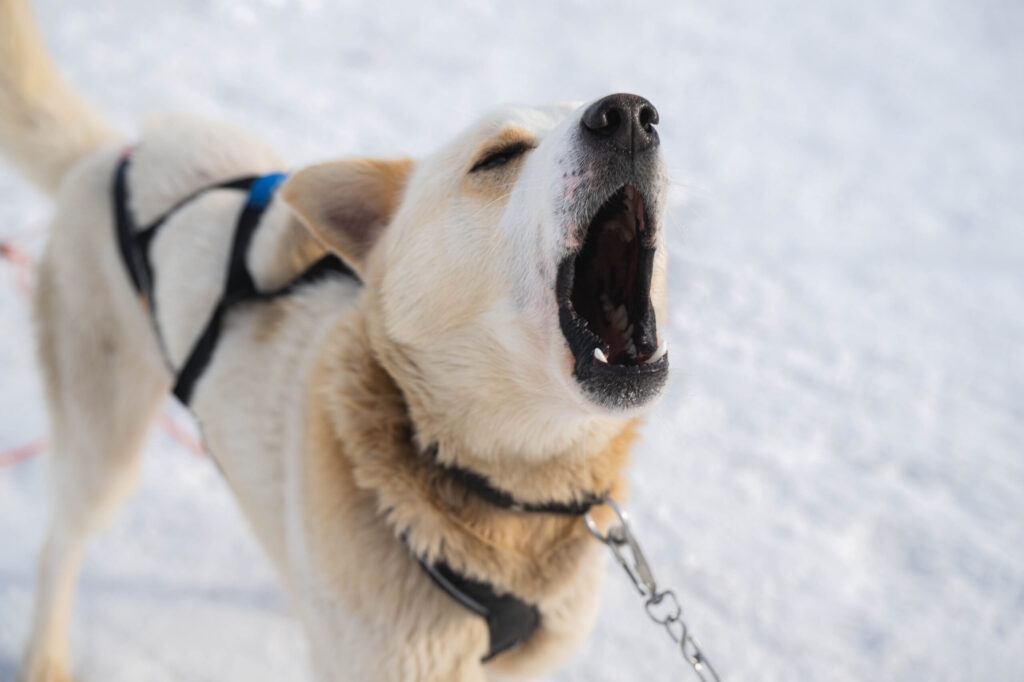
This is how the dogs live in the dog yard
The dog yard is divided into two main areas, where male dogs are gathered in one area and females in another. This is to reduce stress in the male dogs when the females are in heat. In addition, it gives us control over which dogs we want to mate and breed on.
There are separate, fenced areas for puppies and their mothers, as well as for dogs that need distance from the other dogs in the event of, for example, illness or injuries. In the fenced areas, the dogs have the opportunity to move more freely, explore and play with other dogs.
Each dog has its own house, which is placed on four legs slightly above the ground. The dogs are tied to the dog house, but have a radius of approximately two meters in which to move. Each house is placed at a distance which means that the dogs do not enter each other’s home area, and which gives the dogs the opportunity to retreat for some alone time if necessary.
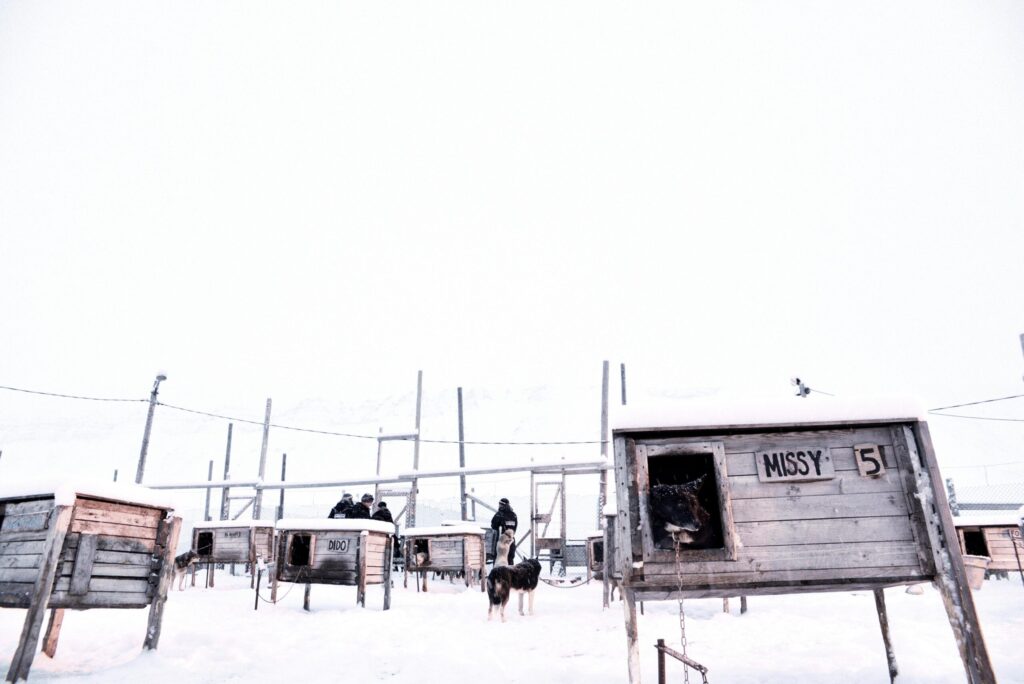
In the doghouses, the dogs have wooden wool that shelters them from the cold. Some dogs empty their homes for wood wool because they prefer to sleep without it or because they prefer to sleep outside with wood wool. It is especially male dogs that clean the house of wood wool. Reindeer antlers are attached to the dog houses, which the dogs chew on for play and dental health (reduces tartar). Some dogs chew several horns a month, while others barely touch theirs.
Food and feeding
An average Alaskan husky needs 5000-8000 kcal per day during normal activity. For longer trips, the calorie requirement is increased to 10,000+. The amount and type of feed is regulated according to the dog’s age and state of health. The dogs get a mixture of dry and soft food. The dry food and soft food are mixed together to form a soup that gives the dog plenty of nutrition and liquid.
In the summer, the dogs get a light meal in the morning and a larger meal in the evening. In winter, the amount of both meals is increased, and in addition there may be a need for a morning meal and snacks if the dogs are out on longer expeditions.
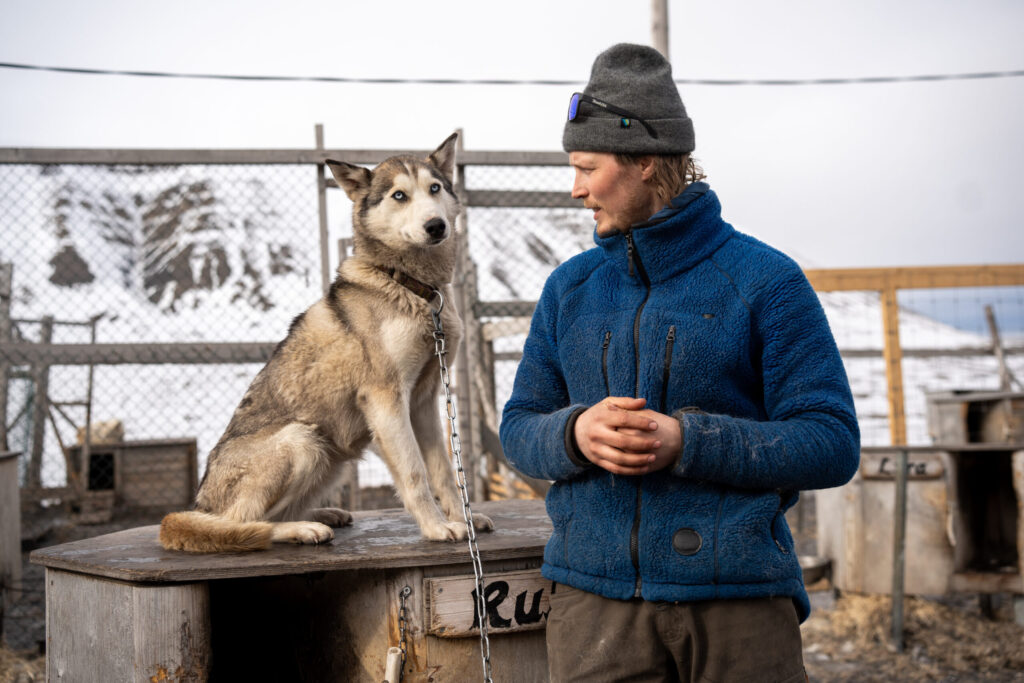
Healthy animal husbandry
Security creates calm, which creates trust!
All the dogs in our dog yard must have the best possible, both mentally and physically. We will talk about the dogs’ rights and look after them. It goes without saying that the dogs should have their surroundings clean, and at least twice a day we remove faeces and clean wood wool.
We feed according to each individual dog’s size, age and activity level, and the dogs have regular access to fresh water (sometimes the water dish becomes a toy that is thrown around).
The dogs are regularly trained, and activated through sled rides with guests or by the dog guides. In addition, some dogs are lucky and get to join us on walks.
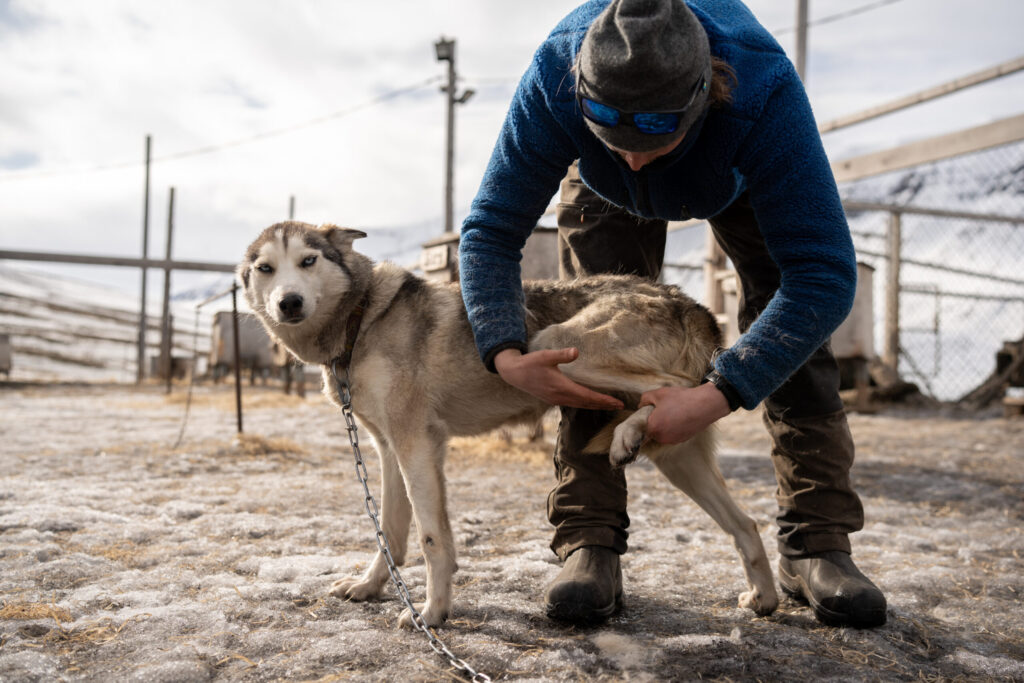
We check our dogs daily for any injuries or illness. We also ask guests to look for abnormal behavior when we are on expeditions. Is there someone who limps or seems sloppy? Speak up!
Sledding dogs in the Arctic can quickly get injured. They can slip on the ice, step over and sometimes even the best friends end up in a fight. Preferably triggered by a female in heat. In case of more serious injuries or illness, the dogs are treated by a veterinarian in Longyearbyen.
Most important of all: Lots of love, time, consideration and security!!!
Our dogs love visits to the kennel, and they compete for attention and cuddles. Some jump and dance on the leash in the hope that you will approach them, while others are more modest and prefer that you approach carefully.
Harnesses and sleds
Each dog gets a harness that is adapted to the dog’s size and physique. That’s why we have many different harnesses. The harnesses must fit well and provide an even load on the body when the dogs are pulling. Large male dogs that pull closest to the sled often have a harness with an inserted “stick” behind the dog. It lowers the pulling point for the dog, and makes it more comfortable to pull.
The dogs are connected to the line set at two points. The front is attached to the dog’s collar, while the back is attached to the harness. This is the pulling point, while the foremost point keeps the dog together in the pack.
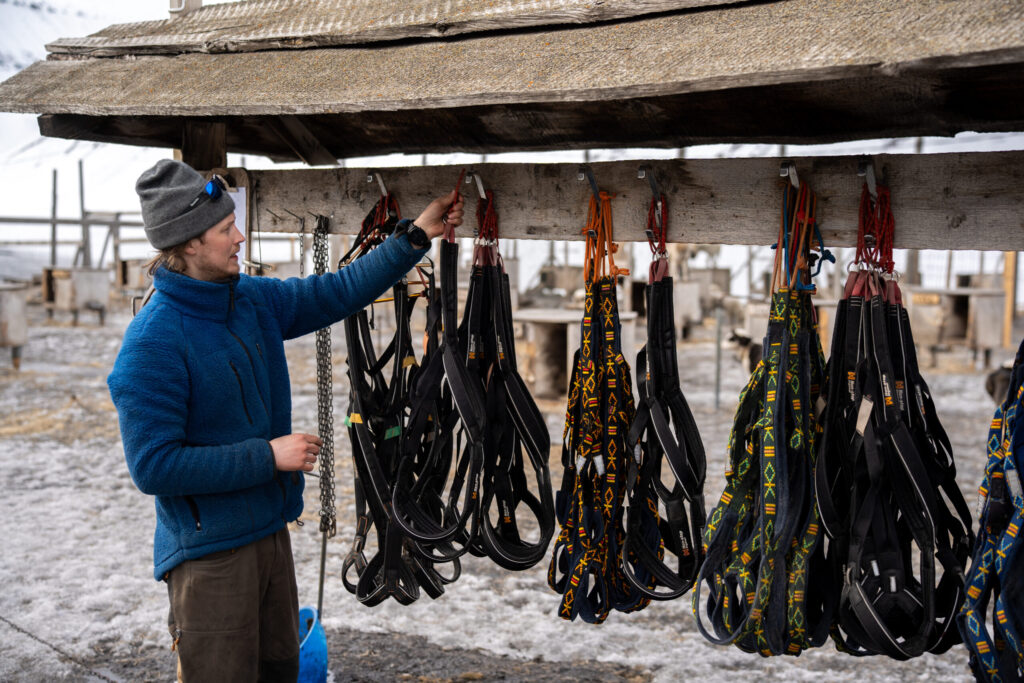
The sled consists of sled runners, brake, storage space and platform for the dog handler. In the storage room passengers or luggage can be loaded (in some cases a sled dog rests in the storage room if it is injured or tired).
The dog handler uses the brake to regulate the speed of the dogs. Especially on downhill slopes, things can go fast, and you have to brake so that the dog has time to move his legs. On uphill slopes or lots of snow, the dog handler often has to help the dogs with the sled.
Fun fact: Dogs are like us, defecation is often triggered by activity. Therefore, you may find that there is a lot of pooing at the start of a trip.
How do dogs react to polar bears and other animals?
The dogs will react differently if they come into contact with polar bears. Some will alert, while others will get scared and will try to run away. If the dogs are on a leash, they can gain extra speed when they smell, for example, reindeer, grouse or other dogs.
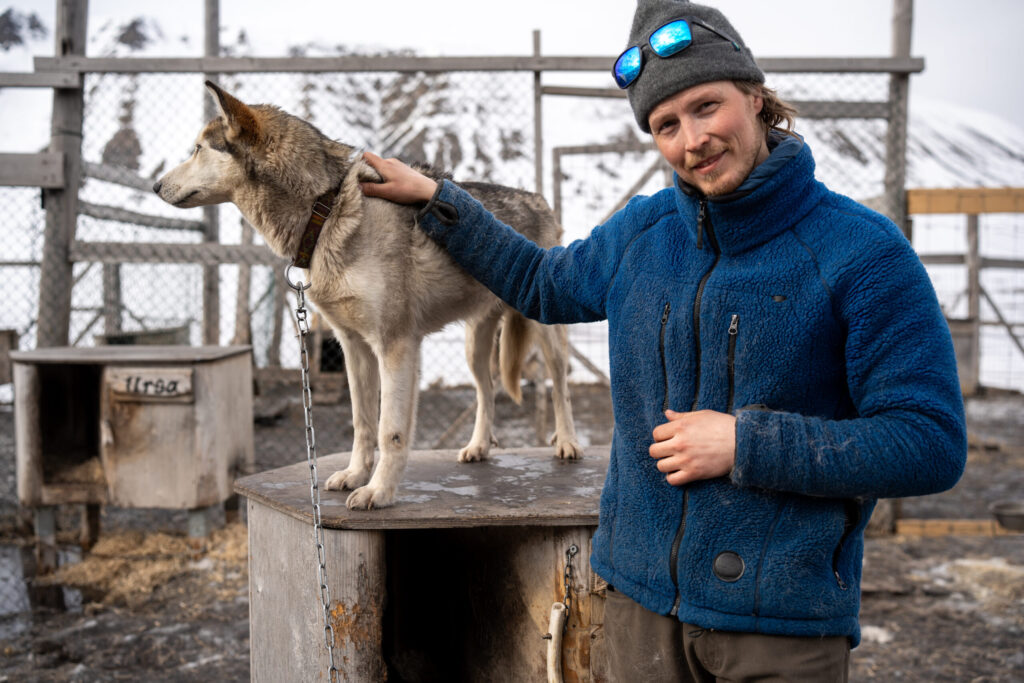
Niklas Wikstrand
This article was written in collaboration with Niklas Wikstrand. He is a dog guide in Basecamp Explorer, and takes guests on, among other things, longer overnight trips with dogs and sleds.
Niklas started dog sledding in 2009, and has run long competitive races in Alaska. He himself has five Alaskan huskies, and has training in the physiological treatment of dogs. Healthy and safe dog keeping is absolutely essential for Niklas, and he uses his theoretical expertise in combination with extensive experience to look after our 80 Alaska huskies.
Niklas has taken various courses in dog anatomy and acupuncture. He treats muscular overloads with massage, and closely monitors whether strain injuries have occurred due to other ailments in the dog.
Bearded seal, ringed seal, Arctic char and cod from the ice-cold sea. Reindeer, ptarmigan and geese from the open tundra and the sharp mountain slopes. In Svalbard, the menu is shaped by the landscape itself.
Hunting and trapping on Spitsbergen date back to the 16th century. For centuries, survival here depended on knowledge, restraint and deep respect for nature. Even today, two professional trappers overwinter on the island, continuing a tradition rooted in self-reliance and careful resource management.
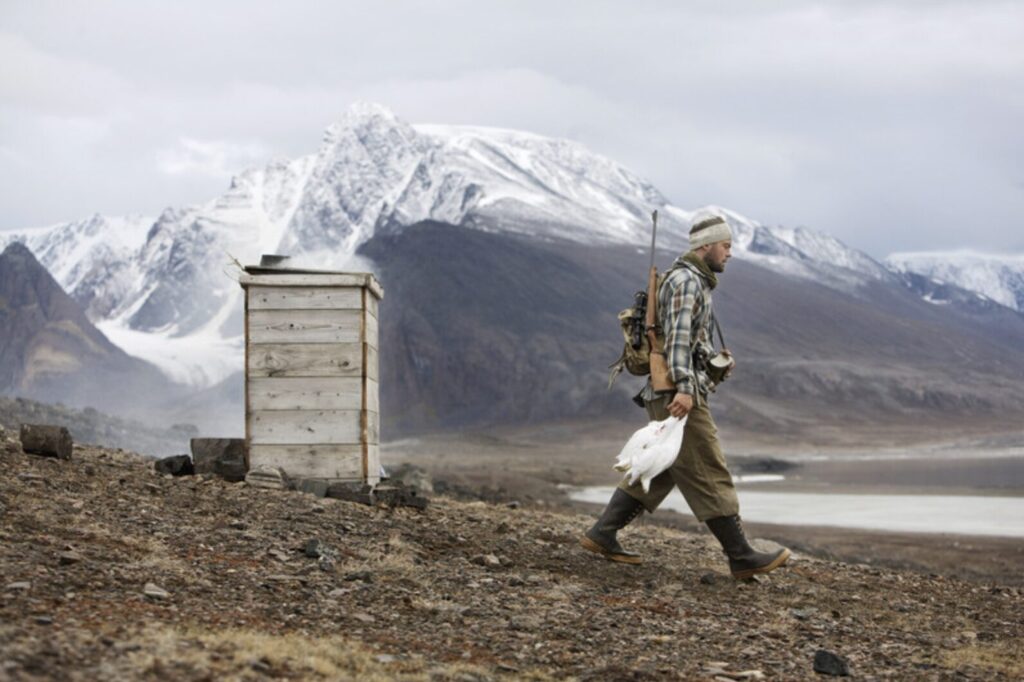
One of them is Tommy Sandal. From his trapping station on Akseløya in the Bellsund area, one of Isfjord Radio’s closest neighbours, he practices traditional trapping methods guided by ecological awareness and sustainability. His work follows strict regulations and seasonal rhythms, ensuring that harvesting remains responsible and balanced.
Head Chef Robert Rydland is in charge of the kitchen at Isfjord Radio. With his long history of creative cooking he creates menus with pure flavours and untraditional combinations.
Our menus are strongly affected of old and almost forgotten preserving techniques. Like the original residents of the outpost, we need to preserver the exclusive ingredients during the dark season months. Salting, curing, dry aging, smoking, drying, pickling and fermenting to mention few. Most of these techniques are to be found in our grandmothers handwritten recipe books, and used earlier on outposts to secure enough provisions over the winter months.
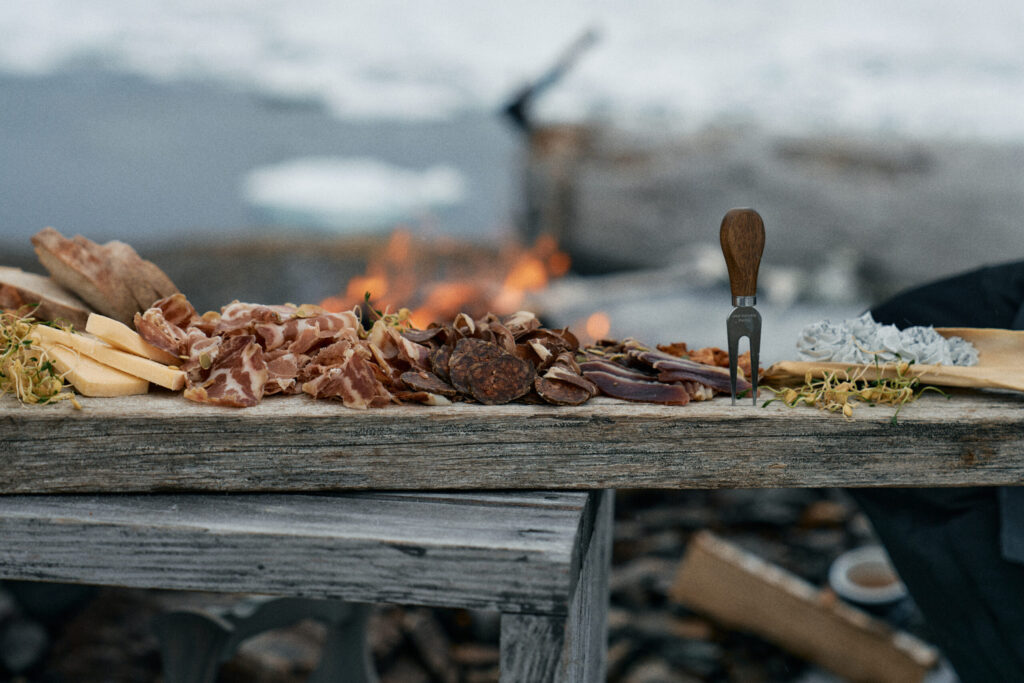
August and September are the main months for hunting, fishing and foraging. For the Isfjord Radio kitchen, this is the most hectic and fun time of the year where our food storages are being stocked with everything from pickled vegetables and dried seaweed to fermented game and cured fish.
During these months we are extending our working hours for some outdoor activities. In the morning and evening hours the kitchen staff can abandon the stove and head to the tundra to harvest mushrooms, walk the shoreline picking edible delicacies and head to the sea for some deep-water fishing. In our storehouse, we are preserving hams, cured meat and sausages and maturing and tenderizing game meat. Working with these tecniques, the produce will last longer and nonetheless enhance the quality.

The growing season on Svalbard is very short and there are limited variables to the local fauna. Thus, our remote boutique hotel simply cant survive exclusively on local ingredients. Therefore our chefs are combining their food philosophy with grocery deliveries from the mainland every half a year. Good dialogues with handpicked fishermen and farmers in Norway gives us stable supply of prime ingredients throughout the seasons.
When staying at Isfjord Radio Station, we aim to promote the arctic nature. At the morning we are serving a traditional Nordic breakfast buffet. Our lunch serving is based on Norwegian home cooking in an historic, yet relaxed environment. In the evening, we are gathering around the dinner table – a real gem of the Isfjord Radio experience. For the dinner we have created a larger menu with several servings, combining the arctic tastes and a customized beverage pairing. Our kitchen and service staff look forward giving you a unique dining experience in the Arctic wilderness.
Welcome home, to your home far away from home.
From minus 35 to plus 75 in nine days. The ski expedition with seven girls started rough with biting cold for several days. But it ended in cozy warmth at Kokeriet at Isfjord Radio.
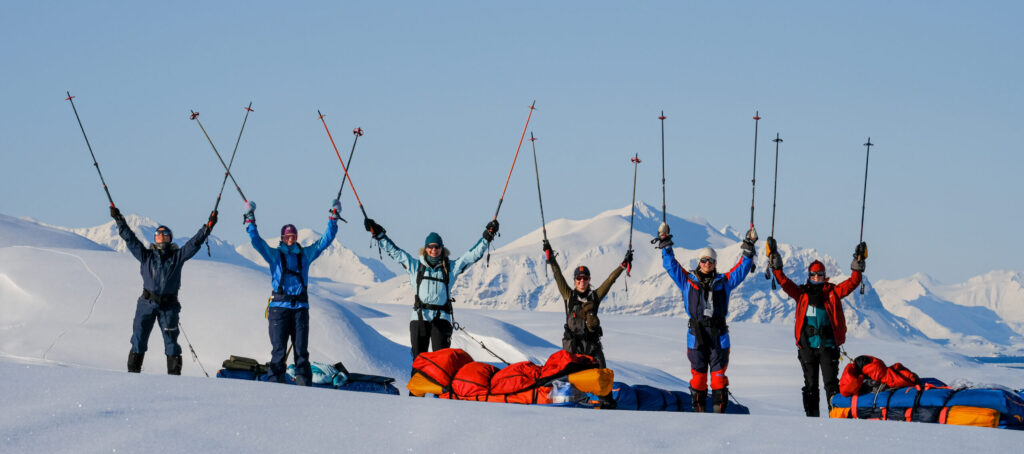
“The first few days were so cold that we struggled to get the stove going. The sub-zero temperatures also made it a bit challenging to sleep. But then it got warmer, going from minus 35 degrees to minus 20,” says Karen Kyllesø (20).
Crossing Svalbard – from Agardhbukta in the east to Kapp Linné in the west. With varying expedition experience in tow, the girls have covered 15-18 kilometers on skis daily for nine days. With approximately 40 kilograms of equipment in the pulk, plenty of energy and strength are needed to tackle both the weather and Arctic terrain. Navigating correctly in wind and whiteouts is crucial. And it’s essential to take turns breaking trail.
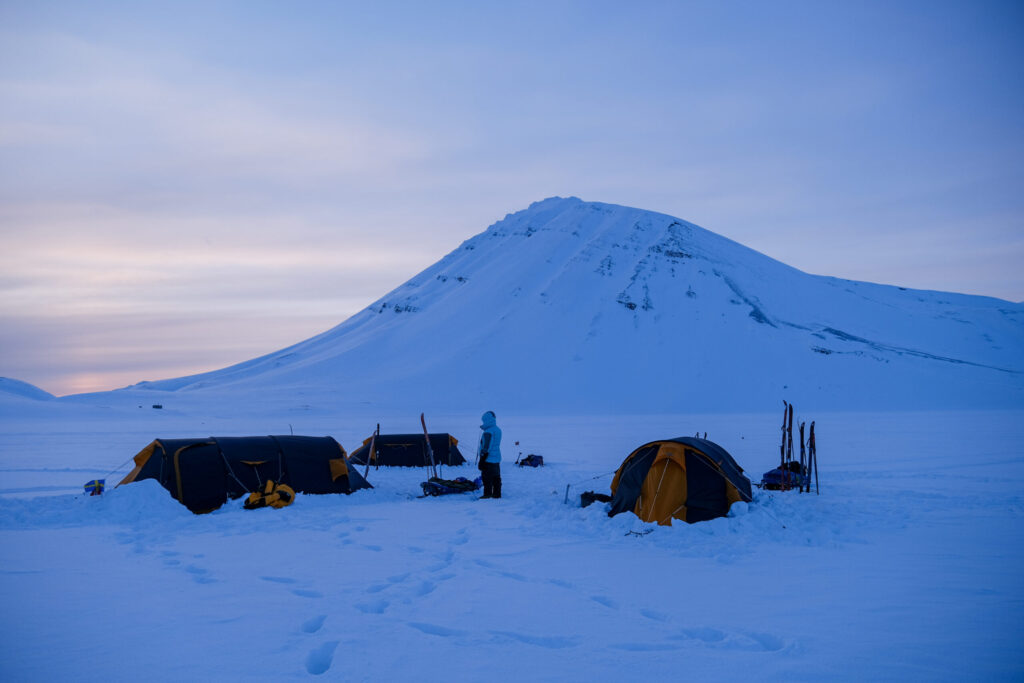
“Svalbard’s nature was surprising. And very different compared to other expeditions we’ve been on. The valleys are so beautiful, and they just keep coming one after the other. Something completely different from what we’ve experienced in, for example, Greenland, Antarctica, and mainland Norway,” says Karen.
Throughout the night, the girls took turns keeping polar bear watch in the bright April night, but the King of the Arctic kept his distance. “Just as well,” says Karen. “We encountered a lot of reindeer, and they’re much nicer than unpredictable bears.”

It’s the first time the seven girls have been on an expedition together. Each day started with a morning meeting to plan the next leg, based on the weather forecast and daily condition. They made sure to share the load and take turns leading. The final stretch towards Isfjord Radio went over Linnévannet, and almost at the station, they were met by a skier with a rifle on his back. Kaja Raa Storaker from Isfjord Radio accompanied the girls the last stretch to the station. And there, they were greeted with a warming fire, freshly baked buns, and coffee.”Isfjord Radio was a mini-expedition in itself, nestled in the wilderness. It was, of course, lovely to curl up under a warm duvet and enjoy local catch, but at the same time, we still had that expedition feeling in us. Out there in unpredictable nature,” says Karen.
“As for swimming in the Arctic Ocean? No, but several of the girls tested the water temperature. Instead, I enjoyed the warmth of the sauna.
Well deserved after long days in many, many sub-zero temperatures.
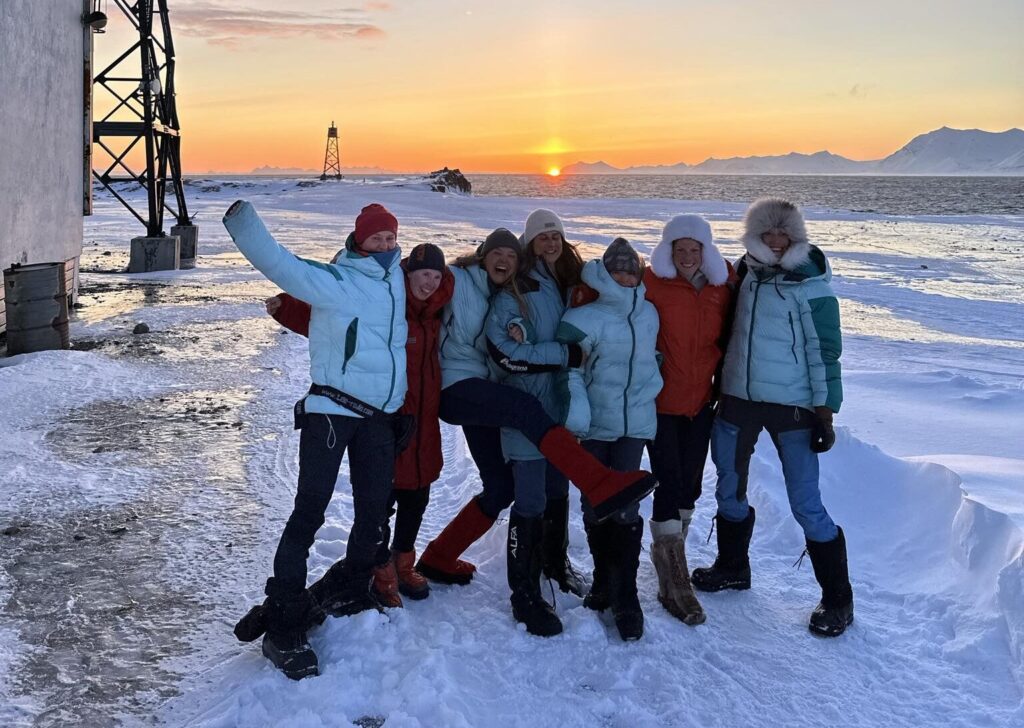
Participants in the expedition April 2024:
Karen Malena Kyllesø (20)
Jannicke Øien (33)
Annik Falck (34)
Regina Johansen (32)
Hedvig Hjertaker (30)
Ragnhild Ongstad (28)
Maria Philippa Rossi (40)
Congratulations on completing the expedition!
All photos: Maria Philippa Rossi
Are you planning a ski expedition in Svalbard?
Please contact us!